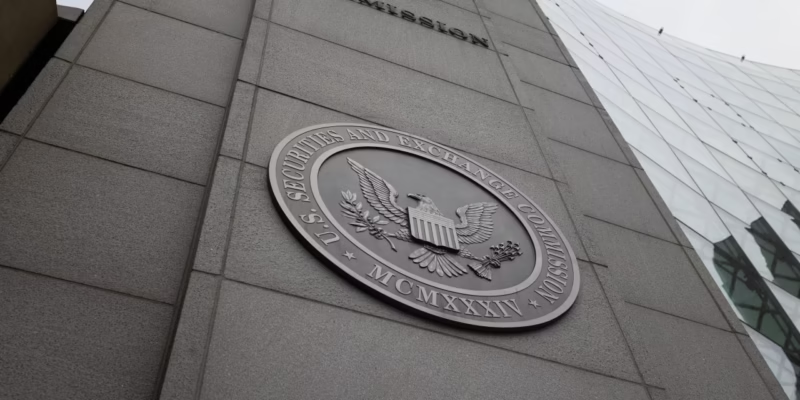
The United States remains the world’s most influential capital market, attracting investment managers, fintech startups, hedge funds, and digital asset companies from across the globe. However, operating within the U.S. financial system requires compliance with strict regulatory frameworks established by the U.S. Securities and Exchange Commission (SEC).
Two of the most important regulatory concepts under SEC supervision are:
- RIA (Registered Investment Adviser)
- STO (Security Token Offering)
Both frameworks govern how financial companies provide investment advice, manage assets, or raise capital in the United States. Understanding these regulatory models is essential for asset managers, blockchain startups, fintech companies, and global investment firms seeking access to the U.S. market.
This guide explains what RIA and STO mean, how they work under SEC regulation, and how companies can legally operate within these frameworks.
1. What Is an RIA (Registered Investment Adviser)?
A Registered Investment Adviser (RIA) is a company or individual registered with the SEC to provide professional investment advice or manage client assets.
RIA regulation is governed primarily by the Investment Advisers Act of 1940, which establishes rules for fiduciary responsibility, client protection, and transparency.
Companies typically register as RIAs when they provide services such as:
- Portfolio management
- Investment advisory services
- Wealth management
- Financial planning
- Asset allocation consulting
- Algorithmic or robo-advisor investment services
The SEC requires advisers managing more than $100 million in assets under management (AUM) to register at the federal level.
Official SEC guidance can be found here:
https://www.sec.gov/investment/advisers
2. Why RIA Registration Matters
RIA registration provides legitimacy and investor protection within the U.S. financial system. Once registered, advisers are legally obligated to act in the best interests of their clients, which is known as the fiduciary duty.
Key benefits of RIA registration include:
Regulatory credibility
Registered firms appear in the public database known as Investment Adviser Public Disclosure (IAPD):
This transparency builds trust with investors.
Ability to manage client assets
RIA firms can legally manage discretionary portfolios for institutional investors, high-net-worth individuals, and family offices.
Global investor access
Many international asset managers register as RIAs to attract U.S. investors.
3. RIA Registration Requirements
To register as an RIA, firms must submit regulatory filings through the Investment Adviser Registration Depository (IARD) system.
The key filing is Form ADV, which includes:
- Firm ownership and structure
- Assets under management
- Investment strategies
- Fee structures
- Compliance procedures
- Conflicts of interest
Form ADV has two main parts:
Part 1 – Regulatory disclosure data
Part 2 – Narrative brochure describing services and risks
SEC Form ADV filing system:
https://www.iard.com
RIA firms must also implement compliance programs including:
- AML (Anti-Money Laundering)
- KYC (Know Your Customer)
- Risk management procedures
- Internal compliance officer appointment
4. What Is an STO (Security Token Offering)?
A Security Token Offering (STO) is a method of raising capital by issuing digital tokens that represent securities such as shares, debt instruments, or investment contracts.
Unlike traditional cryptocurrency ICOs, STOs are regulated under U.S. securities law.
Tokens issued through an STO may represent:
- Equity in a company
- Debt obligations
- Revenue share rights
- Tokenized real-world assets (RWA)
Because these tokens qualify as securities, they fall under SEC jurisdiction.
5. How the SEC Determines Whether a Token Is a Security
The SEC applies the Howey Test, derived from the Supreme Court case SEC v. W.J. Howey Co.
Under the Howey Test, a transaction is considered a security if it involves:
- An investment of money
- In a common enterprise
- With an expectation of profits
- Derived from the efforts of others
If a digital token meets these criteria, it must comply with U.S. securities regulations.
SEC explanation of digital asset securities:
https://www.sec.gov/spotlight/digital-assets
6. Legal Frameworks for STOs in the United States
STOs usually rely on existing securities exemptions to legally raise capital.
The most common frameworks include:
Regulation D (Reg D)
Reg D allows companies to raise funds from accredited investors without full SEC registration.
Common exemptions include:
- Rule 506(b)
- Rule 506(c)
These are widely used for tokenized securities.
Regulation S (Reg S)
Reg S allows securities offerings conducted outside the United States to be exempt from SEC registration.
This is often used for international token investors.
Regulation A+
Reg A+ allows companies to raise up to $75 million annually from both accredited and retail investors with simplified registration.
This is sometimes used for public digital asset offerings.
7. Key Differences Between RIA and STO
Although both are regulated by the SEC, they serve very different functions.
| Category | RIA | STO |
|---|---|---|
| Purpose | Provide investment advice | Raise capital |
| Regulation | Investment Advisers Act | Securities Act |
| Participants | Asset managers, advisers | Startups, blockchain companies |
| Filing | Form ADV | Reg D / Reg S / Reg A+ |
| Investor type | Clients seeking advice | Investors purchasing securities |
RIA focuses on managing investments, while STO focuses on issuing securities through digital technology.
8. The Rise of Tokenized Securities and RWA
STOs are increasingly used for Real World Asset (RWA) tokenization, including:
- Real estate funds
- Venture capital funds
- Private equity
- Infrastructure projects
- Art and collectibles
- Treasury and bond tokenization
Institutional adoption of tokenized securities is growing as blockchain infrastructure matures.
Many analysts believe STOs will become a major capital-raising method in the coming decade.
9. Compliance Challenges for RIA and STO Companies
Companies entering the U.S. market must navigate multiple compliance layers.
Common regulatory challenges include:
- Investor accreditation verification
- Ongoing disclosure requirements
- AML / KYC compliance
- Cross-border regulatory coordination
- Custody and asset protection rules
Failing to comply with SEC regulations can result in enforcement actions, penalties, or restrictions on operating in the U.S.
10. Conclusion
RIA and STO represent two important pillars of the modern U.S. financial regulatory framework.
RIA registration allows firms to legally provide investment advice and manage client assets, while STOs offer an innovative method of raising capital through blockchain-based securities.
As financial markets continue to evolve with digital technology, understanding SEC regulation is critical for global asset managers, fintech companies, and blockchain entrepreneurs seeking to operate legally in the United States.
Firms planning to launch investment advisory services or tokenized securities should ensure they fully understand the applicable regulatory requirements before entering the U.S. market.