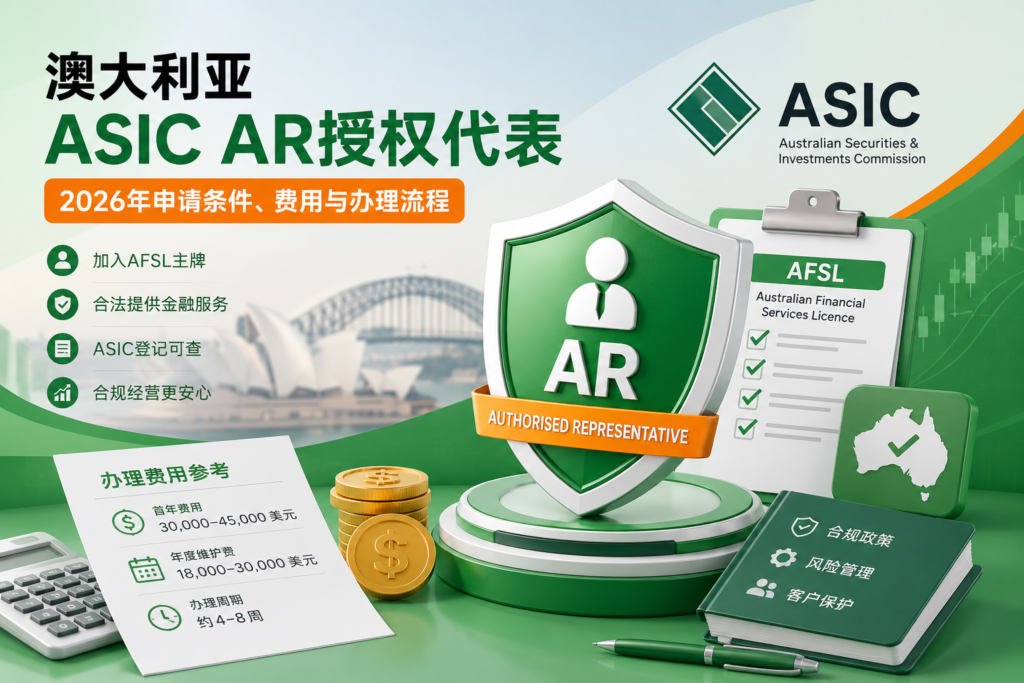
For businesses that plan to enter Australian financial markets but are not yet prepared to apply independently for Australian Financial Services Limited, or AFSL, joining the existing AFSL licensing agency and becoming its Authorised Representative, known as AR, is a common compliance path.
It is commonly referred to in the market as:
- (a) Representative authorized by ASIC AR;
- Australian AR plates;
- (a) A representative authorized by AFSL;
- (a) ASCIC ' s authorized representative;
- Australian Financial Authority Representative.
However, in the legal sense, AR is not an AFSL card held independently by an enterprise.
AR is authorized in writing by the AFSL holder to provide specific financial services on its behalf within the limits specified.
- (a) The licence scope of the main name AFSL itself;
- (a) Written authorization to AR from the owner institution;
- Cooperation agreements signed between AR and the leading agency;
- Product and customer type;
- Experience and competencies of the AR team;
- Internal risk policy of the host institution;
- Application requirements of Australian financial services legislation.
Therefore, an enterprise cannot simply look at whether it owns an ASC AR number, but also needs to identify which financial service lines AR actually receives.
Assessing the ASIC AR program?
COVIS can assist in making a preliminary determination as to whether the existing AFSL mandate is suitable for your project.
I. What is the Australian ASIC AR?
The full name of AR is:
Authorised Representative
The Chinese translation is usually as follows:
Authorized representatives.
According to ASIC of the Australian Securities and Investment Commission, AFS licensees can authorize individuals or businesses to provide designated financial services on their behalf.
The main subject that can be AR is usually:
- (a) Individuals;
- Companies or other legal persons;
- (b) Partnerships;
- A group of trustees composed of individuals or legal persons.
Trusts themselves cannot normally become AR directly, but individuals or legal persons acting as trustees may be authorized.
The services may be part of the licence or multiple of the rights within the licence.
AR does not have access to financial services that do not own the master card.
Official sources:
ASIC:Authorised representatives
ASIC:Appointing and ceasing authorised representatives
Australia Corporations Act 2001
II. ISIC AR IS AN INDEPENDENT FINANCE?
Strictly speaking, AR is not a separate AFSL financial licence.
More precisely:
The enterprise is authorized in writing by an AFSL holder to provide financial services on behalf of the holder within the specified area of business.
The relationship between AR and AFSL is as follows:
- AFSL licensees are authorized;
- AR is the authorized party to conduct business on behalf of the master card;
- AR permissions cannot go beyond the AFSL of the main card;
- (b) The mastership may authorize only part of the financial services;
- The master is required to monitor AR compliance;
- AR needs to comply with master policies, procedures and restrictions;
- (a) The master card may, by law, revoke the AR authorization;
- AR cannot continue to operate with its original mandate after its termination.
Therefore, enterprises should not promote AR as:
- (a) Independent ASIC master card;
- (b) A company owns the AFSL;
- ASIC approves all financial operations of enterprises;
- (a) Full access to financial services can be provided without restriction;
- Obtaining Australian Government investment guarantees;
- Direct operations are possible in any part of the world.
More precise ways of disseminating information include:
- A popular, popular, popular, popular, and non-profit-making organization, AFSL-owned;
- (a) Representative of the Australian AFS Licence;
- Registered in ASIC Authorised Repentatives Register;
- Provision of financial services within the delegated authority of AFSL.
III. What operations can be carried out by ASIC AR?
The operations that AR can carry out are not uniform.
The specific authority depends on the type of authorization held by the main AFSL and the scope of the written authorization that the main card eventually issued to AR.
Possible financial services to be covered include:
- Providing general financial product advice;
- Providing advice on specific financial products;
- (b) Arranging for clients to apply for or obtain financial products;
- (b) Transactions of financial products on behalf of clients;
- (b) Issue or arrange financial products;
- Foreign exchange-related financial services;
- Derivative-related services;
- (b) Services related to the contract for the price difference;
- Services related to securities and investment products;
- (b) Managing investment plan-related services;
- Services related to non-cash payment products;
- (b) Providing designated services to wholesale clients;
- (c) To serve retail customers when additional conditions are met.
Not all AFSLs cover the above operations.
Even if the master card has a licence, the master card may be based on risk, team experience, customer location or product type, and does not delegate full rights to AR.
Before signing AR cooperation agreements, enterprises should check each of the following:
- (a) Master AFSL number;
- (a) The current status of the main card;
- (a) Financial products licensed by the owner;
- (a) The type of customer to whom the licence is issued;
- (b) Whether it is possible to serve retail customers;
- Whether wholesale clients can be served;
- Whether it contains general recommendations;
- (b) Whether to include personal advice;
- Whether to include Dealing or Arranging;
- Whether derivatives, foreign exchange or differential contracts are included;
- Whether AR authorizes the existence of regional or product restrictions;
- Whether AR is allowed to further delegate staff.
Official sources:
ASIC:Giving financial product advice
ASIC Regulatory Guide 36:Licensing—Financial product advice and dealing
IV. Which enterprises are suitable to apply for ASIC AR?
ASIC AR is usually suitable for the following types of projects.
1. Financial science and technology enterprises ready to enter the Australian market
Businesses wish to develop designated financial services in Australia, but are not prepared to apply for AFSL independently for the time being.
Through AR arrangements, operations can be carried out within the mandate and supervisory system of the master card.
2. Foreign exchange and contract-related enterprises
Enterprises that plan to provide services related to foreign exchange, derivatives or price differential contracts may consider joining the AFSL master card with the corresponding competence.
It needs to be noted that foreign exchange and price differential contracts are more risky operations and that master cards are usually subject to more rigorous scrutiny.
3. Investment advisers and wealth management teams
Teams that plan to provide investment advice, product introduction or trading arrangements services to wholesale clients or eligible clients.
Additional educational, examination, registration and vocational standards may be applied when it involves the provision of personal advice to retail clients.
4. Fund and asset management services
Enterprises that plan to provide Australian clients or funds with product promotion, investment arrangements or related financial services.
Whether or not to proceed through AR would need to be judged in relation to the type of fund, the management structure and the scope of AFSL.
Financial products distribution agencies
Enterprises are responsible for introducing, promoting or arranging for the acquisition of specific financial products by their clients and operate in accordance with the compliance system of AFSL-licensed institutions.
6. Start-ups wishing to test the market first
The enterprise wishes to test the product before applying independently for AFSL, establish a client base and understand local compliance requirements.
But AR should not be considered a temporary tool to circumvent AFSL applications.
V. Which enterprises are not suitable for the ASIC AR programme?
The direct adoption of AR programmes is usually not appropriate in the following cases:
- Desiring to have a fully independent control of the regulatory system;
- Reluctance to be subject to continuous monitoring of the main card;
- Refusal to disclose the shareholders and the actual controlling person;
- Lack of information on financial flows and client sources;
- The product is not subject to the permission of the primary AFSL;
- (a) Planning for operations specifically prohibited by the master card;
- (b) The existence of a significant record of litigation, fraud or supervision;
- Only a public number for publicity purposes is expected;
- There is no real business, team or system;
- I hope I can claim to be independent as an AR.
- (b) Plans to engage clients in unauthorized countries;
- Failure to implement customer complaints and risk management systems;
- Refusal to accept transactions, marketing and website reviews.
The FASL master is required to assume responsibility for AR monitoring, and therefore will not normally decide whether to accept the project solely on the basis of the cost of the service.
The main card will focus on whether AR will bring it in:
- Client complaints risk;
- Regulating enforcement risks;
- Financial security risks;
- Anti-money laundering risks;
- (b) reputational risk;
- Cross-border marketing risks;
- (b) Product governance risks;
- Cyber-security risks.
How much is it going to cost to the ASC AR's authorized representative in 2026?
ASIC did not set a uniform commercial service price for AR-CCP.
The actual costs are usually determined by the AFSL lead agency, the project consultant and the relevant service provider on the basis of operational risks and service lines.
The main factors affecting costs include:
- Types of financial services that require authorization;
- Whether foreign exchange or derivatives are involved;
- Whether the contract of difference is involved;
- Retail or wholesale customers of services;
- (a) The country or region in which the client is located;
- (b) The shareholders and control person background of the enterprise;
- Whether Australian companies are needed;
- (b) The need for local leaders;
- Whether professional liability insurance is required;
- Whether client funding arrangements are required;
- Whether the product needs to be issued or distributed;
- (a) The number of expected clients and transactions;
- (a) The supervisory work that the owner is required to undertake;
- Completeness of existing compliance material.
COVIS Consolidated First Year Reference Budget
| Type of project | Consolidated first year reference budget |
|---|---|
| Standard Enterprise ASCIC AR Authorization Program | USD 30,000-45,000 |
| Financial services projects for wholesale clients | USD 35,000-55,000 |
| Foreign exchange, derivatives or differential contract items | Over USD 45,000-$80,000 |
| Multi-area customer or complex product structure | Separate assessment based on risk and scope of operations |
Ongoing monitoring and maintenance of budget
| Ongoing services | Annual reference budget |
|---|---|
| Standard compliance monitoring and delegated authority maintenance | US$ 18,000-30,000 per year |
| High-risk or high-trading items | US$ 30,000-$60,000 per year or more |
| Additional audit, insurance or systems services | Based on actual needs assessment |
The above amount is part of the reference budget for integrated commercial services and is not a uniform official cost as defined by ASIC.
The integrated budget may include:
- (a) Business model assessment;
- AFSL master plate matches;
- (a) A master ' s range analysis;
- (a) Company and equity documentation;
- Due diligence assistance;
- Coordination of AR cooperation agreements;
- Policy readiness for compliance;
- Review of websites and marketing materials;
- (a) ASIC registration assistance;
- Public registration record confirmation;
- Initial compliance training;
- Annual oversight arrangements.
If the business is simple in scope, serves only wholesale clients, has complete materials and is less risky, the actual processing programme may be lower than the public reference budget.
Acquisition of accurate processing costs
The submission of financial products, types of services, customer areas and the expected size of the transaction could be further assessed for the appropriate AFSL master and authorization programmes.
VII. What is the official registration fee for ASIC?
The main costs of the ASIC AR project are usually not derived from the ASC registration fee but from:
- AFSL master licence fee;
- Project review fees;
- (c) Ongoing monitoring fees;
- Compliance service fees;
- Insurance premiums;
- (a) Legal documentation costs;
- Audit and technical system costs.
When AFSL licensees appoint, update or terminate an AR, ASIC may charge a current fee for registering transaction costs.
Some of the costs of ASIC will be indexed on 1 July of each year, and therefore it is not recommended that a fixed amount be described in the long-term article as an official charge that will remain permanent.
Enterprises can search for updated fees on the ASIC official AR registration page.
Official sources:
ASIC: Authorised Representative Register and costs
Special distinctions need to be made:
The costs of the ASIC registration are only the costs of regulating the registration of transactions and are not equal to the costs of the authorization, compliance monitoring and commercial cooperation of the main agency.
VIII. What are the conditions to be met for applying for ASIC AR?
ASIC did not publish a uniform list of business access applicable to all AR projects.
Whether or not the applicant company is acceptable to the owner depends largely on the due diligence and risk policies of the AFSL licensees.
Common requirements include the following.
1. Clear business model
Business needs to state:
- (b) What financial services are available;
- Which financial products are involved;
- (a) Which clients are served;
- (a) Where the customer is located;
- How to access customers;
- How to collect the fees;
- Access to client funds;
- Whether or not to execute customer transactions;
- (b) Whether general or personal advice is provided;
- Whether retail customers are involved.
Clear equity and control structures
Disclosure is usually required of:
- Direct shareholders;
- (a) The ultimate beneficial owner;
- (a) The person in actual control;
- Directors and senior managers;
- Associated companies;
- Regulated entities;
- Historical business records.
Projects with multiple layers of offshore structures, supplanting arrangements or not able to verify the controller are often more difficult to review through the master card.
3. Management teams with relevant experience
The master usually reviews:
- Biographical information on the board;
- Manager experience;
- Experience in financial products;
- Experience in compliance;
- Risk management capacity;
- Previous regulatory records;
- History of client complaints and litigation.
4. Compliance policy and operating regime
Enterprises may need to establish:
- Compliance management system;
- Client classification procedures;
- KYC and the Money Laundering Process;
- (b) Client complaints procedures;
- (b) The marketing material approval process;
- Conflict of interest management;
- Risk management systems;
- Data protection and network security;
- (b) Record-keeping systems;
- Reporting mechanisms for major incidents.
5. Acceptable range of products and customers
Part of the master card only accepts:
- Wholesale clients;
- Specific investment products;
- (b) Clients of specific countries;
- Businesses that do not have access to client funds;
- No individual recommended business.
If an enterprise wishes to provide retail customers with high-risk products or services, the review requirement is usually significantly increased.
Insurance and financial capacity
The master may require AR:
- (b) Join the master of professional liability insurance;
- (b) To purchase additional insurance on their own;
- Provide financial statements;
- (b) Provide proof of operating funds;
- (b) Payment of a bond or risk reserve;
- To cover the costs of compliance review.
Specific requirements are determined by operational and master policy.
IX. What information is required to prepare for the request for ASIC AR?
Company information
- (a) Certificate of incorporation of the company;
- (a) The charter of the company;
- (b) Shareholders ' lists;
- Roster of directors;
- The address of the company ' s registration;
- Main office address;
- ABN or ACN information;
- Group organizational chart;
- (a) Related business information;
- The company website and domain names.
Shareholders and actual controllers
- (a) Passport or identification;
- (a) Address certificate;
- Shareholding ratio;
- (b) A description of the sources of funding;
- Biographical information;
- (b) Regulatory records;
- (a) Record of proceedings;
- Other company positions.
Management information
- (b) Detailed curricula vitae;
- Experience in the financial sector;
- Professional qualifications;
- (b) Regulatory record;
- (b) The scope of the operations for which it is responsible;
- Compliance and risk management experience;
- Information on past projects.
Operational information
- Business plans;
- Target clients;
- (a) The country in which the client is located;
- Types of financial products;
- Business processes;
- (a) The manner in which the fees are charged;
- (a) The expected volume of transactions;
- Customer access;
- Marketing schemes;
- Description of financial flows;
- Introduction to technical systems;
- Information on third-party service providers.
Compliance information
- Compliance manual;
- Risk management policy;
- Client classification procedures;
- (a) The KYC and AML policy;
- Client complaints processing;
- Conflict of interest policy;
- Marketing review system;
- Data protection policy;
- (b) Cybersecurity plan;
- Business continuity plan;
- (b) Record-keeping systems;
- Incident reporting procedure.
Websites and marketing materials
- (a) Website pages;
- Product description;
- Risk disclosure;
- User protocols;
- Privacy policy;
- Client agreements;
- – Advertising material;
- Social media content;
- (c) Means of communication for benefits and performance.
X. ASIC AR COMPLETE PROJECT
Step 1: Assessing whether business is a financial service
An analysis of whether an enterprise provides:
- Financial product advice;
- (b) Transactions in financial products;
- (b) Arranging for clients to obtain financial products;
- (b) Financial product distribution;
- Hosting or related services.
Step two: determine the required AFSL mandate
Identifying business needs:
- What kind of financial products;
- What type of financial services;
- Retailing or wholesale customers;
- General or personal advice;
- Whether it involves Dealing;
- Whether derivatives or foreign exchange are involved.
Step 3: Matching the right AFSL master
Check master:
- AFSL status;
- (b) Financial services competence;
- Financial product categories;
- Client type;
- (a) Regulatory history;
- Number of existing ARs;
- Risk policy;
- Accepts the relevant business.
Step 4: Completion of the initial project assessment
Submit to main card:
- Business introduction;
- Equity structure;
- Management team;
- Product description;
- Target clients;
- (a) The country of operation;
- The expected size of the transaction;
- Information on the website.
Step 5: Due diligence
The main card may be used by businesses and associated personnel:
- (b) Identification;
- Background checks;
- (b) Regulatory record queries;
- Sanctions and negative news screening;
- Business model reviews;
- Financial capacity review;
- Technical systems review.
Step six: Preparation for compliance
Adjust to master requirements:
- Client access;
- KYC;
- Risk disclosure;
- Marketing processes;
- (b) Handling of complaints;
- (b) Monitoring of transactions;
- (a) Document preservation;
- The incident was reported.
Step 7: Signing AR cooperation agreement
The agreement usually needs to be clear:
- Scope of the mandate;
- Client type;
- (a) Product coverage;
- Service areas;
- (b) The responsibilities of both parties;
- Compliance monitoring;
- Cost structure;
- Insurance arrangements;
- (b) Compensation provisions;
- (b) Termination mechanisms;
- Client and data attribution.
Step 8: Written authorization
AFSL licensees issue formal written authorization to the applicant to identify the financial services that AR can provide.
Step 9: Notification of ASCIC
AFSL licensees or licensed Authoriser submitted AR appointment information through ASCIC Online Services.
ASIC provides that notice shall normally be given within 30 working days after the authorization has taken place.
Step 10: Confirmation of public registration
Once submitted online, ASIC ' s Authorised Repentatives Register usually updates and assigns AR numbers immediately.
Step XI: Completion of pre-line review
Business websites, contracts, risk disclosures and marketing materials are cleared for business as per delegated authority.
Step XII: Implementation of ongoing monitoring
AR is subject to acceptance during the operation of:
- Periodic reports;
- (a) Speculation of documents;
- Client complaints checks;
- Advertising audit;
- Compliance training;
- (b) Control of transactions;
- Annual review;
- Significant incident reports.
Official sources:
ASIC:Notifying ASIC of an AR appointment
How long will it take for ASIC AR to process?
The public register can be updated as soon as AR registration itself is submitted on the master card completion line.
However, the main time spent on the project as a whole is usually:
- (a) Master plate matching;
- Operational review;
- (b) Due diligence by shareholders;
- Management review;
- (b) Documentation preparation for compliance;
- (b) Website improvements;
- (b) Negotiation of cooperation agreements;
- Insurance arrangements;
- Check and approve before you go online.
Where the material is complete and operational clarity is clear, standard projects normally recommend retention:
About four to eight weeks.
The following may be extended to 8 to 16 weeks or longer:
- (b) In respect of foreign exchange, derivatives or differential contracts;
- (b) Planning to serve retail customers;
- Clients come from multiple jurisdictions;
- (b) Complex equity structure;
- (a) Inadequate information on managers;
- The product needs to be redesigned;
- (a) The existence of non-compliance campaigns on the website;
- (a) In relation to the funds of the client;
- The compliance system needs to be reformulated;
- The need for professional liability insurance;
- Additional legal advice is required for the master.
These are references to the timing of projects and are not fixed approval periods as set out in the ASC.
How long after AR's appointment can it be checked in with ASIC?
The AFSL licensees usually update their appointments immediately after they have been submitted through the ASIC online system.
Public information may typically include:
- AR name;
- AR number;
- (a) the name of the primary AFSL;
- (a) Master AFSL number;
- Date of inception of AR;
- Current status;
- Whether there is a further enabling capacity;
- Partial business or contact information.
Official Query Entry:
ASIC Professional Registers Search
Attention needs to be paid to:
The search for AR in the ASIC register only proves that the subject is registered as an authorized representative by an AFSL holder and does not prove that it has full licence to own the master card.
Clients also need to see:
- Associated AFSL master card;
- (a) The scope of the licence;
- AR ' s written authorization;
- (a) The current status of AR;
- (b) Whether the authorization has been terminated;
- Product and customer restrictions.
XIII. Does the ASIC AR need to be renewed annually?
Unlike regular updates such as FinCEN MSB, there is not necessarily a uniform “re-appliance” system.
However, AR usually requires sustained business cooperation and compliance with the AFSL master.
Common annual work includes:
- (a) Pay annual fees for the authorization and supervision of the master card;
- Update information on shareholders and managers;
- Updating insurance;
- Subject to annual compliance review;
- Completion of staff training;
- Update the risk assessment;
- Financial and operational reporting;
- Update of websites and marketing materials;
- (c) Handling of complaints from clients;
- Update the ASIC registration information;
- Review of the scope of the mandate.
When the name, address, scope of authorization or other registration data change, the master card is usually required to notify ASI within a specified period of time.
The official ASIC stated that it should normally be updated within 30 working days of the relevant change.
14 and AFSL. Can you cancel AR at any time?
AFSL licensees may revoke AR authorization by written notification.
The AR cooperation agreements usually also provide that:
- (a) What circumstances constitute violations;
- (a) What operations can be immediately suspended by the master;
- How client complaints are handled;
- How regulatory risks will end when they occur;
- (b) How clients can be organized after termination;
- The website and how to get it off the line.
- How AR numbers are discontinued;
- How to treat outstanding costs and compensation.
Common reasons for termination include:
- (a) To operate beyond its mandate;
- (c) Unauthorized advertising;
- (a) Providing false or misleading information;
- Failure to report client complaints;
- Rejection of compliance review;
- Significant regulatory issues have arisen;
- Violation of anti-money-laundering requirements;
- (a) Failure to pay dues;
- Undisclosed changes in shareholders or controlling persons;
- (a) Master adjustment risk policy;
- The master licence itself has changed.
Therefore, AR does not amount to an Australian financial licence permanently obtained by an enterprise.
15, can AR further authorize employees?
Some ARs can further empower the individual to provide financial services on behalf of the AFSL holders with written consent.
This is often called:
Sub-authorisation。
Corporate ARs usually require the actual operation of the business through employees, directors or other natural persons, and may require further authorization of the person concerned.
However:
- (a) The consent of the master card must be obtained;
- Only within the scope of the master and AR authorizations;
- (b) The need to comply with the requirements of the ASIC notification;
- The owner is still required to supervise the persons concerned;
- Some may also need to be registered with the Financial Advisers Register.
Additional professional standards and ASIC registration requirements may be required if individuals provide retail customers with individual advice on Relevant Financial Products.
Official sources:
ASIC:Who can be an authorised representative
ASIC:Registration for relevant providers
What's the difference between ASIC AR and AFSL?
| Comparative items | ASIC AR | AFSL Master |
|---|---|---|
| Legal nature | Owner Authorized Representative | Independent financial service holders |
| Source of authorization | AFSL licensees | ASIC |
| Hold a card independently | Yes | Yes. |
| Operational authority | Depending on the master and written authorization | Depending on the AFSL license. |
| Difficulty of application | Relatively low | Higher |
| Processing time | Usually shorter. | Usually longer. |
| Compliance monitoring | Subject to master oversight | Self-obligation to hold cards |
| Operational independence | Subject to Master Limit | Relatively higher |
| Regulatory responsibilities | AR and the main card have obligations. | Master assumes full card obligations |
| Can the authorization be revoked? | Yeah. | Need to be addressed by regulatory procedures |
| Fit for business | Initial or specific business team | Institutions that are mature and want to operate independently |
AR may be more appropriate if enterprises simply wish to enter the market faster.
If the enterprise wishes:
- Independent control of the full compliance system;
- Self-determination of financial products;
- (a) Automating other bodies;
- Establishment of a permanent Australian operation;
- Reduce reliance on third-party master cards;
The independent application for AFSL could be further assessed.
What difference does it make between ASIC AR and ASC regulatory inquiries?
The public register of ASIC AR is part of the regulatory information on financial services, but the search cannot be made by reference only to the name of the business.
The complete verification shall normally include:
Step 1: Query AR Subject
Confirm:
- AR name;
- AR number;
- Status;
- Date of commencement;
- Link the main card.
Step 2: Query AFSL master
Confirm:
- AFSL number;
- Name of company holding a licence;
- (a) The status of the licence;
- Financial services coverage;
- Product category;
- Client type.
Step 3: Checking the authorization relationship
Confirm:
- Whether AR is still associated with the master card;
- (i) The existence of multiple master cards;
- (a) Whether there is a right to further authorization;
- Whether AR publicity goes beyond the main card.
Step 4: Reconciling website disclosures
AR ' s website and business documents should normally clearly describe its relationship with the AFSL master card, so as to avoid making clients mistaken that AR itself is an independent holder.
XVIII. What circumstances would increase the processing costs of ASIC AR?
The project budget is usually increased by:
- The right to apply for foreign exchange or derivatives;
- (a) Planning for the implementation of the contract;
- Retailing customers of services;
- Providing personal financial advice;
- Contact or control of the funds of the client;
- Multi-country outreach;
- Multilayered offshore equity structures;
- Lack of relevant experience of managers;
- Websites and promotional materials need to be substantially revised;
- A complete compliance system needs to be established;
- Additional professional liability insurance is required;
- (a) The expected high volume of transactions;
- High-risk customers or countries exist;
- The need to authorize multiple staff;
- Third-party technology and monitoring systems are needed.
On the contrary, the final programme may be lower than the public budget if the enterprise:
- (b) Services only wholesale clients;
- Lack of access to client funds;
- Single product range;
- Clear management team experience;
- Simple equity structure;
- (a) Already have an Australian company;
- A compliance manual exists;
- Complete website and contract information.
XIX. Common problems with ASIC AR
1. Can non-Australian residents apply for ASIC AR?
An assessment can be made.
While the ASIC rules allow different types of subjects to become ARs, the actual acceptance of offshore shareholders or offshore management teams depends on the risk policy and business arrangements of the AFSL master.
2. Must Australian companies be registered first?
It should not simply be understood that Australian companies are required by ASC for all projects.
Most enterprise AR projects, however, will use Australian companies and prepare ABN, ACN, local address and management arrangements to meet the ownership, banking and business operations requirements.
Can AR do the foreign exchange business?
AR can only be carried out within the scope of the authorization if the AFSL owner has the relevant licence and the written authorization explicitly covers the corresponding financial services and products.
4. Can AR conduct a contract differential?
The master card is required to have corresponding derivatives or associated privileges and to accept the business model.
The price differential contract is a high-risk retail product that is usually subject to stricter compliance review.
5. Can AR serve global clients?
Australia ' s AR registration alone cannot be recognized as serving a global customer.
Businesses still need to assess the financial licensing, cross-border marketing and consumer protection requirements of the customer ' s location.
6. Can AR use all the permissions of the master card?
Cannot be used by default.
AR can only use the powers specified in the written authorization.
Can AR numbers be consulted at ASIC?
Yes.
The appointment information is usually shown in Authorised Repentatives Register when submitted via the ASCC online system.
8. Does AR need a compliance officer?
Within enterprises, there is usually a need to designate personnel responsible for compliance and monitoring.
The specific job and personnel requirements depend on the scope of the operation and the master policy.
9. Does AR require professional liability insurance?
AFSL masters may require AR to join their insurance arrangements or to purchase separate professional liability insurance.
Specific requirements vary from project to project.
10. Can AR receive direct collection of customer funds?
It cannot be judged solely on the basis of AR identity.
The ability to access or process client funds needs to be assessed in the context of AFSL competencies, written authorizations, customer fund systems, hosting and banking arrangements.
Can AR promote the ASI company?
It is not recommended that this be the case.
It should be made clear that the enterprise is an AFSL licensed agency, Authorised Representative, rather than describing itself as an independent AFSL holder.
12. Does the AR application guarantee success?
No guarantee.
The final acceptance of the project is determined by the AFSL master, based on due diligence, operational risk and compliance capacity.
Representative services authorized by COVISASIC AR
COVIS may assist in:
- Assessment of the applicability of the ASIC AR;
- Analysis of the scope of the AFSL mandate;
- Suitable initial match for the main card;
- Equity and control structures combo;
- (b) Management documentation;
- Preparation of business plans;
- Analysis of financial products and types of customers;
- (b) Due diligence information preparation;
- Coordination of AR cooperation agreement processes;
- (b) Documentation of compliance;
- Review of websites and marketing materials;
- (b) ASIC public registration verification;
- Ongoing compliance and annual oversight arrangements;
- AR compares with the independent AFSL programme.
Get ASIC AR processing
The open integrated budget mainly covers projects of different risk and complexity.
If an enterprise only serves its wholesale clients, does not have access to client funds, has a clear scope of operations and completes the material, the actual programme may be lower than the public budget of this paper.
The following information is submitted for preliminary assessment:
- Planned financial services;
- Financial products involved;
- Retail or wholesale customers;
- (a) The country or region in which the client is located;
- Access to client funds;
- Whether Australian companies are currently in existence;
- (a) The background of the directors and management team;
- Projected number of clients and size of transactions.
Source and official link
1. Introduction by the accredited representative of ASIC
ASIC:Authorised representatives
2. AR Appointment, authorization and termination rules
ASIC:Appointing and ceasing authorised representatives
3. Which subjects can become AR
ASIC:Who can be an authorised representative of an AFS licensee
4. Request to notify ASCIC after appointment
ASIC:Notifying ASIC of the appointment of an AFS authorised representative
5. ASIC AR Open Register
ASIC:Authorised Representative Register
6. ASIC professional registration search portal
ASIC:Professional Registers Search
7. Guidance on financial product recommendations and licensing of transactions
8. Ongoing obligations of AFS licensees
9. Requirements for registration of individual recommended persons for retail clients
ASIC:Registration for relevant providers
10. Australian Financial Services Act
Australian Government:Corporations Act 2001
Price description
The $30 000-45,000 and other budgets presented here are the integrated commercial reference budgets of COVIS, based on the complexity of the project, the scope of its mandate and the ongoing compliance services.
The budget is not an official application price as set by ASC, nor does it represent a flat fee for all AFSL licensees.
The actual costs would need to be determined on the basis of:
- Type of financial services;
- Financial product categories;
- Retailing or wholesale customers;
- The location of the client;
- The size of the transaction;
- (a) Master risk policy;
- Insurance requirements;
- Team experience;
- Completeness of compliance material;
- Ongoing monitoring of workload.
Disclaimer
This paper is intended for general information purposes only and does not constitute an Australian legal opinion, a financial licensing opinion, an investment proposal or a regulatory approval commitment.
The specific business that the enterprise can perform is based on the current licence of the AFSL master, a formal written authorization, a mutual agreement and applicable law.
Prior to the formal development of Australian financial services, targeted legal and compliance assessments should be conducted based on specific products, customer types, marketing areas and funding arrangements.