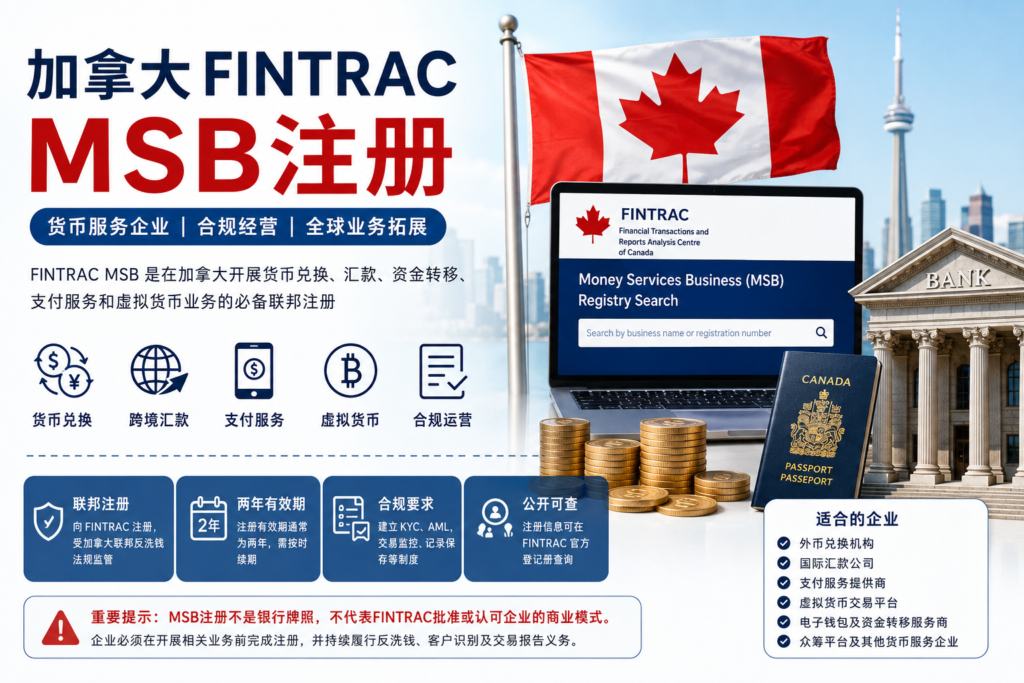
The registration of FINTTRAC Money Services Business is one of the important federal compliance requirements for enterprises planning to conduct transactions related to currency exchange, cross-border remittances, money transfers, payment services or virtual currency transactions in Canada.
The full name of the MSB is:
Money Services Business
The Chinese language is commonly known as:
- Money service enterprises;
- (b) Money service enterprises;
- Registration of MSBs in Canada;
- FINTRAC MSB;
- Canada pays or transfers licences.
However, by its legal nature, the Canadian MSB is more precise:
Under the Proceeds of Crime (Money Laundering) and Financing of Terrorist Activities Act of Canada, businesses have completed the registration of money services businesses with FINTRAC.
The full name of FINTRAC is:
Financial Transactions and Reports Analysis Centre of Canada
FINTRAC monitors compliance with Canada ' s anti-money laundering, counter-terrorism financing and financial transaction reporting requirements.
Whether an enterprise needs to register depends primarily on the actual services provided, rather than whether the words “payment” “financial” “remittances” or “digital assets” appear in the name of the company.
Assessing Canada's MSB registration?
By submitting your business model, the location of the client, the flow of funds and whether they involve a virtual currency, COVIS may assist in making a preliminary determination as to whether it is appropriate to register MSBs in Canada or foreign MSBs.
I. What is the Canadian FINTRAC MSB?
Enterprises operating specific monetary services in Canada are required to register with FINTRAC before they begin providing services to the public.
Common operations that may belong to MSB include:
- Foreign currency exchange;
- (b) Remittances or transfers of funds;
- Issuance or exchange of money orders;
- Issuance or exchange of traveller ' s cheques;
- Processing virtual currency transactions;
- (a) Partial payment for services;
- Part of the platform service.
Businesses located outside Canada that provide and target related services to Canadian customers may also be identified as Foreign Money Services Business, a foreign currency service provider.
The main roles of FINTRAC registration are:
- (b) Informing regulatory bodies of the identity of the enterprise;
- Identification of the type of monetary services provided by enterprises;
- Inclusion of enterprises in anti-money-laundering controls;
- Require enterprises to establish and implement compliance systems;
- Facilitate risk assessment and compliance inspections by regulators.
Attention needs to be paid to:
FINTRAC does not issue MSB with traditional financial licences or certificates of registration, nor does it provide official credit endorsements to enterprises.
The presence of an enterprise in the public register of FINTRAC only proves that it meets the corresponding registration requirements and that it authorizes its products, secures the funds of its clients or recognizes its ability to operate.
Official sources:
FINTRAC:Money Services Businesses
FINTRAC:Money Services Business Registry
II. What business needs to be registered with MSB Canada?
1. Foreign currency exchange
An enterprise provides a client with one legal currency for the exchange of another.
Common scenarios include:
- (a) The dollar in exchange for the United States dollar;
- (a) The United States dollar to the euro;
- (b) Online currency exchange;
- (b) Underline foreign currency exchange;
- Currency conversion in cross-border settlements.
2. Remittances or transfers of funds
The enterprise receives funds from its clients and sends them to another person, another company or another region.
Common scenarios include:
- International remittances;
- Transfers within Canada;
- Cross-border payments by enterprises;
- Vendor payments;
- Wage payments;
- Electronic wallet transfers;
- Commercial funds settlement.
3. Bills of exchange or traveller ' s cheque operations
The enterprise issues, sells, cashes or redeems:
- (b) Bills of exchange;
- Traveller ' s cheques;
- Similar negotiable payment instruments.
4. Virtual currency operations
An enterprise may be a virtual currency, MSB, when providing:
- (b) Exchange of French and virtual currency;
- One virtual currency for another;
- Transfer of virtual currency on behalf of clients;
- (a) Receive and send virtual currency to third parties;
- Partial hosting of digital wallets;
- Digital asset payment services.
5. Partially paid services
If the paying service provider actually receives and transmits the customer's funds, it may constitute MSB.
An analysis is required for the determination:
- Whether the enterprise controls the customer ' s funds;
- (b) Whether or not to determine the path to the transfer of funds;
- Whether payments are made to third parties;
- Whether technical interfaces are provided only;
- Whether or not it falls within the scope of immunity or exclusion.
6. Partially organized platforms
Partially raised platforms for raising and transmitting funds or virtual currency for clients may also require registration of MSB or Foreign MSB.
Official sources:
FINTRAC:Check Whether You Need to Register as an MSB
FINTRAC:Crowdfunding Platforms and Certain Payment Service Providers
III. What is the difference between Canada ' s MSB and its Foreign MSB?
The Canadian regulatory system distinguishes the relevant enterprises into:
- MSB in Canada;
- Foreign Money Services Business, FMSB.
MSB Canada
Generally applicable to:
- Have a place of business in Canada;
- Employment in Canada;
- Establishment of an office in Canada;
- Provision of monetary services from Canada;
- Operating in Canada.
Foreign MSB
Generally applicable to:
- (a) The enterprise is located outside Canada;
- There is no place of business for Canadian entities;
- However, they offer related services to Canadian clients;
- Promotion or promotion in the Canadian market;
- Use of Canadian domain names, advertising or targeted marketing;
- Monetary or virtual currency services are provided to Canadian residents.
Foreign MSBs are usually also required to arrange service to agents in Canada and to submit company, manager, controller and background information as required by FINTRAC.
Enterprises cannot automatically avoid the regulation of the MSB in Canada by simply registering servers or companies abroad.
Official sources:
FINTRAC:Register Your MSB or Foreign MSB
Canadian MSB Registration Regulations
IV. CANADAMSB IS A FINANCE PRACTICE?
Strictly speaking, FINTRAC MSB should not be described as a complete Canadian payment licence or bank licence.
More precise formulations include:
- FINTRAC Registered Money Services Business;
- Registered currency service enterprises in FINTRAC, Canada;
- Federal MSB registration in Canada has been completed;
- You can search for it in the FINTRAC public register.
Inaccurate or misleading statements include:
- Obtaining a Canadian Government financial licence;
- FINTRAC authorizes enterprises to carry out all payment operations;
- The Government of Canada guarantees the funds of its clients;
- (b) Be registered to operate a bank;
- Registration allows for a global payment operation;
- FINTRAC recognized or certified the investment platform.
FINTRAC has made it clear that MSB registration does not represent a licence, endorsement or endorsement of an enterprise.
What is the official registration fee for FINTTRAC Canada for 2026?
FINTRAC MSB registration itself does not normally charge government application fees.
In other words, when an enterprise submits MSB or Foreign MSB registration directly to FINTAC, it is not required to pay the fee for applying for a fixed licence according to the type of service.
However, official registration is free and does not mean that the entire project is cost-neutral.
Businesses may still:
- Canadian company registration fees;
- Registration address;
- (a) Company secretary or agent services;
- (a) Canadian service agent;
- Background information on shareholders and managers;
- Certification of criminal record;
- Business plans;
- Description of financial flows;
- AML/CFT compliance system;
- Risk assessment;
- (b) Compliance arrangements;
- (b) Staff training;
- Biennial independent effectiveness review;
- KYC and the trading monitoring system;
- Due diligence in banks or payment corridors;
- Ongoing reporting and compliance maintenance.
A distinction should therefore be made between:
The official registration fees of FINTTRAC are not the same as the fees for companies, documents, compliance and declaration services provided by professional bodies.
Official sources:
FINTRAC:MSB Registration Process
How much is it going to cost to get into the Canada MSB in 2026?
There is no uniform market service price for MSBs in Canada.
The actual budget usually depends on:
- Registration of MSBs in Canada or foreign MSBs;
- Whether Canadian companies need to be registered;
- Number of shareholders and directors;
- Whether offshore shareholders are involved;
- Whether cross-border remittances are carried out;
- Whether virtual currency is involved;
- Need for customisation of AML systems;
- (a) Whether Canadian service agents are required;
- Operational website available;
- Whether there is a KYC and transaction monitoring system;
- Completeness of available information.
COVIS integrated project reference budget
| Type of project | Integrated reference budget |
|---|---|
| Standard Canadian Company and FINTRAC MSB Registration | USD 8,000-15 000 |
| There is a Canadian company, only MSB and basic compliance. | Individual assessment based on material completeness |
| Cross-border payments, remittances or multi-share structure | USD 12,000-22,000 |
| Virtual currency and complex financial flow projects | USD 18,000-35,000 |
| Foreign MSB and cross-border operations | USD 20,000-40,000 or more |
The above amounts are part of the commercial reference budget of COVIS based on the full range of services, and are not an official FINTRAC application fee and do not represent a single offer for all market services.
The integrated projects may include:
- MSB applicability assessment;
- Comparison of MSB and Forest MSB pathways in Canada;
- Canadian company registration;
- (b) Structure of shareholders and controllers;
- Preparation of registration data;
- Description of operations and financial flows;
- Canada served the proxy assessment;
- (b) Compliance arrangements;
- AML/CFT policy;
- The KYC procedure;
- Risk rating system;
- Sanctions screening process;
- Suspicious transaction reporting system;
- (b) Staff training programmes;
- (b) Independent effectiveness review planning;
- FINTRAC registered for assistance;
- Public registration confirmation.
The final service option may be lower than the public budget if the enterprise already has a Canadian company, a clear business model, a complete website and compliance system.
Access to MSB cost assessment in Canada
The submission of your business type, client country, financial flows and whether they involve virtual currency can be further assessed.
VII. What are the conditions to be met by Canada ' s MSBs?
1. Clear business model
Enterprises need to make clear that:
- What monetary services are provided;
- Who's the customer?
- (a) The countries in which the customer is located;
- How funds are channelled;
- How funds are transferred;
- Who is responsible for the final payment;
- Control of client funds;
- Whether virtual currency is involved;
- How to collect the fees;
- Which banks, paying or technical cooperation parties are used.
Clear corporate and control structures
Usually, provision is required for:
- (a) The legal name of the company;
- Business names;
- (b) Company registration information;
- Registration address;
- Business address;
- Directors;
- Chief Executive Officer;
- President;
- shareholders or controlling persons who directly or indirectly hold 20 per cent or more interest;
- Associated enterprises.
Partial offences, money-laundering, terrorist financing or a serious financial criminal record may result in applicants not being eligible for registration.
3. Compliance officer
Enterprises must appoint a compliance officer with sufficient authority, knowledge and resources to implement the FINTRAC compliance system.
4. Written compliance policies and procedures
Businesses need to develop their own business, rather than simply replicating generic templates.
The system should cover:
- (a) Customer identification;
- (a) The beneficial owner is identified;
- Client risk rating;
- Enhanced measures for high-risk clients;
- (b) Sanctions risks;
- (b) Control of transactions;
- Suspicious transaction reports (STR);
- (a) Large transaction reports;
- Record-keeping;
- Third-party judgement;
- Keep monitoring.
5. Risk assessment for money-laundering and terrorist financing
Enterprises need to assess the following risks:
- Client type;
- Products and services;
- Area of operations;
- (b) Channels of trade;
- High-risk countries;
- Virtual currency;
- Non-face-to-face clients;
- Agents and third parties;
- Sanctions avoid risk.
6. Staff training programme
Ongoing compliance training is required for staff involved in customer clearance, transaction processing, reporting and risk management.
7. Biennial effectiveness review
Enterprises need to plan and review the effectiveness of compliance at least every two years.
FINTRAC currently summarizes compliance as five core elements:
- (b) The compliance officer;
- Compliance policies and procedures;
- Risk assessment;
- Ongoing training;
- Effectiveness reviews are conducted every two years.
Official sources:
FINTRAC:Compliance Program Requirements
FINTRAC:Supervisory Assessment Manual
What information does Canada's MSB need to prepare?
Company information
- (a) Certificate of incorporation of the company;
- (a) The charter of the company;
- Registration number;
- Date of registration;
- Registration address;
- Main business addresses;
- (a) The company ' s website;
- Telephone and e-mail;
- (b) The date of commencement of operations;
- Information on branches.
Shareholders and controllers
- (a) Passport or identification;
- (a) Address certificate;
- Shareholding ratio;
- Control relationships;
- (a) The organizational chart of the company;
- Lists of directors and managers;
- 20% or more of shareholders;
- (a) Proof of applicable criminal record;
- Related business information.
Operational information
- Business plans;
- Type of service;
- Client type;
- The location of the client;
- (a) Financial flow maps;
- The expected amount of the transaction;
- The expected number of transactions;
- Fees patterns;
- Banks and payment partners;
- Virtual currency wallets or platform arrangements;
- Information on the agent or branch office.
Compliance information
- AML/CFT compliance manual;
- (b) Customer identification procedures;
- (a) The beneficial owner is identified;
- Client risk rating;
- Sanctions screening system;
- Reporting procedures for suspicious transactions;
- (a) The reporting procedure for large transactions;
- (b) Record-keeping systems;
- Third-party judgement procedures;
- (b) Staff training programmes;
- Plan for independent effectiveness review.
IX. MSB complete processing process in Canada
Step 1: Assess whether it belongs to MSB or Foreign MSB
The regulatory identity is determined by the location of the enterprise, the location of its customers, the manner of marketing and the flow of funds.
Step 2: Identification of business service categories
Confirm that the enterprise provides:
- Foreign currency exchange;
- (a) Transfer of funds;
- Remittances;
- (a) A bill of exchange or a traveller ' s cheque;
- Virtual currency;
- Other currency services are applicable.
Step three: Establishment or organization of corporate bodies
A Canadian company was established on the basis of the project, or the subject of the offshore Foreign MSB application was processed.
Step 4: Recognition of shareholders and control structures
(b) Collating information on directors, CEOs, CEOs and over 20 per cent of shareholders or controllers.
Step 5: Preparation of operational and financial flow statements
Show clearly:
- Client opening;
- KYC;
- (a) Filling;
- Exchange;
- Transfers;
- Collections;
- (a) Cash withdrawals;
- Refunds;
- Unusual transaction processing.
Step VI: Establishment of a compliance system
Preparation of compliance manuals, risk assessment, training plans and two-year review arrangements.
Step 7: Submission of applications for pre-registration
Submitted to Pre-registration Form through the FINTRAC system.
Step 8: Response to FINTRAC Supplementary Questions
FINTRAC may request additional:
- Business model;
- Equity structure;
- (a) Financial flows;
- (b) Services to the State;
- Managers;
- (b) Agents;
- Virtual currency operations;
- (c) Application for qualification.
Applicants are usually required to respond to requests for clarification within the time limit set by the supervision.
Step 9: Official registration completed
Once the application is processed, the enterprise will obtain a public registration status and registration number in the FINTRAC registry.
Step 10: Confirming public search records
Check:
- (a) Legal name;
- Business names;
- Registration number;
- Business address;
- Type of service;
- (a) Registration status;
- Date due;
- Whether to be marked as Foreign MSB.
Step XI: Ongoing compliance
Completion of customer clearance, transaction monitoring, reporting, record-keeping and system updating.
Official sources:
FINTRAC:Register Your MSB or Foreign MSB
X. How long does the Canada MSB generally take?
FINTRAC did not commit itself to processing all MSB registration applications within a single fixed period.
The actual project time usually depends on:
- Whether the company has been established;
- (b) Clarity in the shareholder structure;
- Whether it involves Foreign MSB;
- Whether virtual currency is involved;
- Completeness of the background information;
- Whether FINTRAC has requested clarification;
- Speed of response by the applicant.
From the perspective of the full project, reference can be made to:
| Type of project | Comprehensive reference cycle |
|---|---|
| Standard Canadian Company MSB Project | 4-8 weeks |
| Cross-border remittance or multi-shareholder project | 6-12 weeks |
| Foreign MSB project | 8-16 weeks |
| Virtual currency or complex capital flow projects | More than 10-20 weeks |
This is a practical reference for the project and is not a deadline for approval as defined or guaranteed by FINTRAC.
FINTRAC may request additional information from the applicant; if it does not respond in a timely manner, the application may be rejected or registration may be withdrawn.
XI. How often does Canada ' s MSB renew?
FINTRAC MSB and Foreign MSB registrations are usually valid:
Two years.
An enterprise is required to submit an application for renewal prior to the expiration of its registration.
If the deadline is not extended, the status of registration may appear to be Expired.
Enterprises also need to be updated in a timely manner when:
- Name of the company;
- Business names;
- Address;
- Contact person;
- Directors;
- CEO or CEO;
- Shareholders and controlling persons;
- Type of business service;
- Branches;
- (b) Agents;
- Websites;
- Business stopped.
If an enterprise no longer provides MSB services, an application for cessation of registration should be submitted within 30 days of the cessation of business.
Official sources:
FINTRAC:Update, Renew or Cease an MSB Registration
XII. What transaction reports are required from the Canadian MSB?
Depending on the operation, MSB may need to submit:
- Suspicious Transaction Report;
- Large Cash Transaction Report;
- Electronic Funds Transfer Report;
- Large Virtual Currency Transaction Report;
- Terrorist Property Report;
- Other regulatory reports applicable.
For example, when an enterprise receives a virtual currency of the equivalent value of $10,000 or more, it is usually required to submit the Large Vital Transport Report.
The 24-hour consolidation rule may also be applied if the same client or beneficiary makes multiple transactions within 24 consecutive hours and the reporting threshold is met.
Enterprises also need to:
- (a) Identification of the customer;
- (b) To determine the existence of a third party;
- (b) Keep a copy of the report;
- (a) Keep records of relevant transactions;
- Continuous monitoring of high-risk clients.
Official sources:
FINTRAC:Reporting Large Virtual Currency Transactions
FINTRAC:Financial Transactions Reported to FINTRAC
XIII. What can be done by MSB in Canada?
Depending on the actual scope of registered services, MSB may:
- Foreign currency exchange;
- International remittances;
- Transfer of funds within Canada;
- Electronic wallet transfers;
- (b) Commercial payments and settlements;
- (b) Bills of exchange and traveller ' s cheques;
- Virtual currency exchange;
- Virtual currency transfers;
- (a) Partial payment for services;
- Some fund-raising services.
However, FINTRAC MSB does not automatically confer the following powers on enterprises:
- (b) Seizing public deposits;
- (b) Banking operations;
- (b) The granting of supervised loans;
- Providing portfolio investment services;
- Operating funds;
- All payment operations are automated in all Canadian provinces;
- circumventing consumer protection requirements;
- Guarantee that banks or payment agencies must open accounts;
- It operates freely in all countries of the world.
An enterprise also needs to assess, on the basis of its specific business:
- Canada's retail payment activity regulation;
- (b) Provincial consumer protection;
- Bank cooperation requirements;
- Securities regulation;
- Virtual asset and stabilization currency rules;
- (c) The law of the customer ' s location.
Can Canada's MSB do virtual money operations?
This could be done upon completion of the corresponding virtual currency operation registration and compliance requirements.
Common operations include:
- French for virtual currency;
- (b) Virtual currency exchange;
- Exchange between virtual currencies;
- Transfer of virtual currency on behalf of clients;
- Partial hosting and payment services.
The virtual currency MSB needs to focus on:
- Risk screening of wallet addresses;
- Analysis of block chain transactions;
- High-risk wallet identification;
- Screening of sanctions lists;
- Review of sources of funding;
- Customer identification;
- (a) Large virtual currency transaction reports;
- Suspicious transaction reports (STR);
- Travel Rule Process;
- Record-keeping.
The registration of FINTRAC itself does not automatically resolve:
- (b) Securities-type token regulation;
- Derivative regulation;
- (b) Provincial securities trading platform requirements;
- Banks and access to French currency;
- Virtual asset licences in other countries.
XV. Do banks have to be opened when they have access to the Canadian MSB?
No guarantee.
Independent review of banks, payment institutions and the Chamber of Commerce for French-currency services:
- Shareholders and controlling persons;
- Management team;
- Client countries;
- Type of business;
- The size of the transaction;
- (a) Financial flows;
- AML system;
- (b) Control of transactions;
- Virtual currency risk;
- (b) Sanctions risks;
- FINTRAC registration status;
- (b) The actual operation of the company;
- Other licenses or permits.
The mere existence of FINTRAC registrations, without a real business system, complete compliance or clear funding streams, is generally not sufficient to pass through rigorous due diligence by financial institutions.
XVI. What are the circumstances that make MSB registration or compliance problematic?
Common problems include:
- The business model is not well described;
- (a) Incomplete information on the application;
- Inaccuracy of information on shareholders and controlling persons;
- (a) The question of FINTRAC was not answered in a timely manner;
- (a) The lack of consistency between the business and the application after registration;
- There is no compliance officer;
- Use of generic templates for AML files;
- No risk assessment has been conducted;
- (b) There is no training of staff;
- (a) Effectiveness reviews are not carried out every two years;
- (b) The registration information was not updated in a timely manner;
- (a) The delay in the renewal;
- Failure to submit STRs;
- (a) Failure to maintain customer and transaction records;
- Virtual currency operations do not have wallet risk monitoring.
In 2026, FINTRAC may impose administrative fines on non-compliant enterprises, and may refuse or revoke registration.
XVII. Common Canadian MSB issues
1. Can non-Canadian residents apply for MSB in Canada?
An assessment can be made.
Offshore shareholders may establish Canadian companies, but there is a need to provide real shareholders, directors, controllers and business information.
2. Must Canadian companies be registered?
If a business has a place of business in Canada, a Canadian company is usually used to register MSB.
Foreign MSB paths may apply to businesses that are wholly offshore but provide services to Canadian customers.
3. Does Canada ' s MSB have minimum capital requirements?
FINTRAC MSB registration itself does not normally have a uniform fixed minimum capital requirement applicable to all enterprises.
However, enterprises still need to have sufficient operating capital and to meet the financial requirements of banks, payment corridors, other regulatory regimes and commercial partners.
4. Can Canada ' s MSB make payments?
Practical operational assessments may be made, but not all payment technology services are MSBs or all payment activities require only FINTRAC registration.
5. Can Canada ' s MSB make remittances?
This could be done following the registration of funds transfer services and the implementation of the corresponding compliance system.
6. Can Canada ' s MSB make a digital currency transaction?
Virtual currency-related MSB services can be requested, but securities, derivatives, hosting and other regulatory requirements need to be assessed.
7. Will registration be completed to serve global clients?
Canada ' s MSB registration alone cannot be considered to operate in all countries of the world.
Enterprises still have to comply with the law of the customer ' s location.
8. Would FINTRAC issue a paper licence?
FINTRAC does not issue licences or certificates of registration to MSB in the traditional sense.
Enterprises check their registration status mainly through the FINTRAC public register.
9. Do MSB need to be renewed annually?
Not every year.
FINTRAC MSB is normally renewed every two years, but compliance and reporting obligations require continuous implementation.
10. Can MSB registration guarantee passage?
Can't.
FINTRAC will decide whether to complete registration on the basis of the qualifications of the enterprise, the background of the shareholders and managers, the application information and the response information.
11. Will registration be checked by FINTRAC?
Maybe.
FINTRAC can assess whether an enterprise is meeting its obligations by means of questionnaires, document reviews, compliance checks and other monitoring.
12. Where can I find the MSB of Canada?
The following can be accessed through the official registry of FINTRAC:
- Name of business;
- Registration number;
- (a) Registration status;
- Type of service;
- Address;
- Date due;
- Whether it belongs to the Foreign MSB.
Official Query Entry:
FINTRAC:Money Services Business Registry
COVIS Canadian FINTRAC MSB Application Service
COVIS may assist in:
- (b) The MSB applicability assessment of Canada;
- MSB and Foreign MSB path analysis;
- Canadian company registration;
- (a) Stock and control organization;
- Information preparation for directors and managers;
- Description of operations and financial flows;
- (b) Planning of cross-border remittance operations;
- Virtual currency business analysis;
- Canada served the proxy assessment;
- Preparation of FINTRAC pre-registration data;
- AML/CFT compliance system;
- KYC and client risk rating;
- Sanctions screening process;
- Reporting procedures for suspicious transactions;
- (b) Staff training programmes;
- Two-year effectiveness review planning;
- FINTRAC questions response assistance;
- Public registration record confirmation;
- Two-year extension and ongoing compliance planning.
Source and official link
1. Canadian MSB Regulatory Note
FINTRAC:Money Services Businesses
2. MSB and Foreign MSB registration process
FINTRAC:Register Your MSB or Foreign MSB
3. Determination of whether registration of MSB is required
FINTRAC:Check Whether You Need to Register
4. MSB Open Register
FINTRAC:Money Services Business Registry
5. Update, renewal and discontinuation of registration
FINTRAC:Update, Renew or Cease an MSB Registration
Canada's Anti-Money Laundering and Counter-Terrorism Financing Act
Government of Canada:Proceeds of Crime (Money Laundering) and Terrorist Financing Act
7. Canada ' s MSB Registration Act
Government of Canada:MSB Registration Regulations
MSB compliance requirements
FINTRAC:Compliance Program Requirements
9. MSB record-keeping requirements
FINTRAC:Record Keeping Requirements for MSBs
10. Large virtual currency transaction reports
FINTRAC:Reporting Large Virtual Currency Transactions
Price description
The consolidated budget of US$ 8,000 to US$ 40,000 is presented here as a commercial reference budget of COVIS based on the structure of the enterprise, type of business, complexity of the project and range of services.
The budget is not an official registered price as stipulated by FINTRAC, nor does it represent a uniform offer for all market services.
The following items will normally need to be calculated separately or in combination:
- Canadian company registration;
- Registration address and agent;
- (a) Canadian service agent;
- (b) Background papers for shareholders and managers;
- AML/CFT system;
- KYC and the trading monitoring system;
- Independent effectiveness review;
- Banks and payment corridors;
- Ongoing regulatory reporting;
- Two-year renewal of service.
The final price will need to be determined on the basis of the business model of the enterprise, the location of the customer, whether it involves a virtual currency or not, and the material available.
Disclaimer
This paper is used only for general information purposes and does not constitute a Canadian legal opinion, bank opening guarantee, regulatory approval commitment or investment proposal.
FINTRAC MSB registrations are primarily part of the Canadian Federal Anti-Money Laundering Regulatory Register and do not amount to bank licences or all payment business licences.
Before a firm formally carries out a currency exchange, remittance, money transfer, payment or virtual currency operation, it shall conduct a targeted legal and compliance assessment in accordance with actual financial flows, client areas and the latest regulations.