Global institutional investors, family offices, sovereign funds and high net value clients have long been against Cayman Foundation and Delaware Fund Very high acceptance. Hedge Fund, Crypto Fund, Private Equity, VC, and Quantified Fund Cayman + Delaware Double Fund Structure (Master-Feeder Structure)。
Such a structure not only has tax efficiency advantages but also meets the same strategy of engaging United States investors with overseas investors. It is now the most commonly used, mature and regulatoryly friendly private fund structure in the world.
This book, written by COVIS LTD, will be comprehensively analysed from the perspective of structure, processes, compliance, taxation and fund-raising:
- What is the Cayman Foundation structure?
- How does a double-layer structure work?
- Why does almost all hedge funds use Cayman + Delaware?
- What are the advantages of BVI, Hong Kong, Singapore VCC?
- Compliance requirements for the establishment of the Offshore Fund
- How does US raise money with Reg D?
- Is encryption fund, family office fund, global distribution applicable?
I. Why is the Cayman Fund the first option for the Global Offshore Fund?
Cayman Foundation by Cayman Islands Regulation, whose regulatory body is: Cayman Islands Monetary Authority(CIMA)In the long term, provide the most mature regulatory environment for global hedge funds and offshore funds.
The reasons why the Cayman Foundation is globally popular include:
:: 0 per cent enterprise income tax
Cayman does not levy on the Fund itself:
- Corporate income tax
- Capital gains tax
- Interest tax
- Equity tax
Suitable for cross-border investment.
• High level of global institutional recognition
Almost all:
- Hedge funds
- Global Macro Fund
- Quantified funds
- Encryption Fund
- Private equity funds
- Family Office Fund
Both use Cayman as the Offshore carrier.
CIMA Regulatory Development + International Common Structure
CIMA has a large number of international compliance agreements (OECD, FATF, IMF) for a globally recognized light regulatory system.
:: The investor is not subject to nationality restrictions
Attracts:
- Investors outside the United States
- High net value clients in Asia
- Sovereign Fund for the Middle East
- European institutions
- Local Office
ii. Delaware Fund fit for American investors (most professional Onshore architecture)
Delaware is one of the most centralized jurisdictions in the United States.
Delaware Fund structure includes:
- Delaware LP
- Delaware LLC
- Delaware Feeder Fund
- Delaware Master Fund
Its advantages include:
The legal system is the most friendly
It has the most sophisticated private and investor protection legal system in the United States.
LP Structure Global
The Limited Partnership model is particularly suitable for the Fund.
It's a perfect match for U.S. fund-raising.
In particular:
- Reg D
- Form D
- 506(b)/506(c)
- Blue Sky Filing
• The highest level of investor awareness
American institutions LP traditional preference for Delaware, not other states.
III. MAster-Feeder Two-tier Fund Structure (the most commonly used global funding architecture)
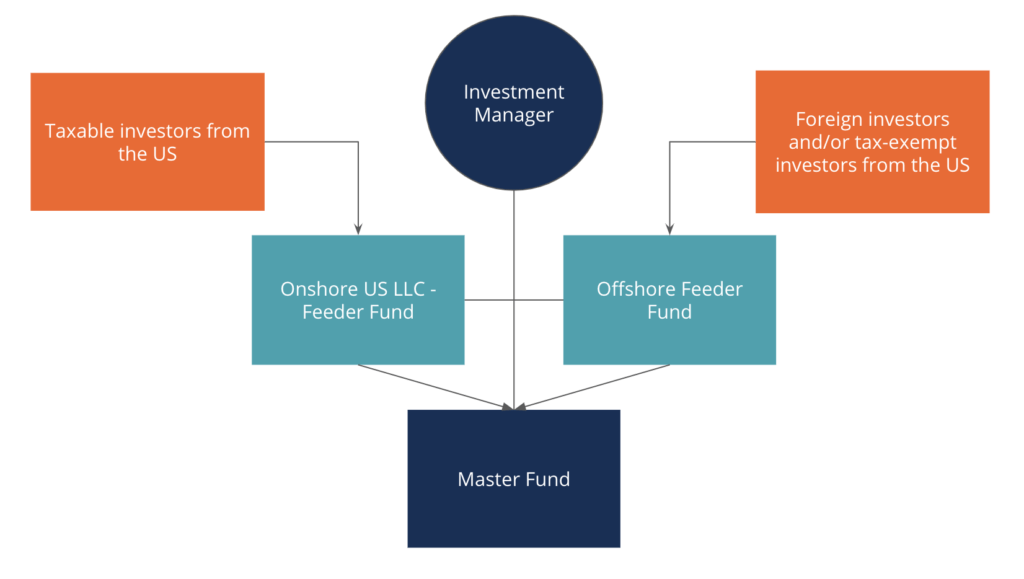
Master-Feeder (Mother-Child Foundation) consists of three components:
1⃣ Cayman Master Fund
Responsible for actual investments (stocks, bonds, futures, encrypted assets, derivatives, etc.).
2⃣ Cayman Feeder Fund (offshore feeder)
Intake:
- Non-United States investors (Non-US)
- International agencies LP
- Encrypted Asset Investor
3⃣ Delaware Feeder Fund (US feeder)
Intake:
- Qualified American investor
- United States Family Office.
- United States institutions (pensions, insurance companies, PE)
Three relationships:
US Investors → Delaware Feeder →
                                 → Cayman Master → 投资标的
Non-US Investors → Cayman Feeder →
This allows the Fund to:
- Maintaining portfolio harmonization
- Separate different investor categories
- Improving tax efficiency
- Simplified audit and operational structure
iv. Cayman + Delaware 8 Great Strengths of a Double-Standing Structure (Founding Fund's favorite cause)
1. Tax efficiency is highest
Offshore and Onshore investors are separate and do not interact.
2. Participation of United States investors with overseas investors
There is no need to duplicate multiple fund entities.
3. The highest level of global institutional recognition
Almost all mainstream LPs are used to this structure.
4. Positive fund-raising (shared by Reg D + Reg S)
- U.S. investors use Reg D (506(b)/506(c))
- Non-United States investors use Reg S (exemption from offshore issuance)
5. All asset classes
Equity, futures, CTA, quantification, hedge, digital assets, credit, real estate, etc.
6. Global bank, voucher, custodian support
This is the case of Morgan Stanley, Goldman, HSBC, DBS, Interactive Brokers.
7. Compliance requirements are transparent and manageable
Cayman + Delaware has clear regulatory mechanisms.
8. Easier to expand and internationalize
Sub-funds, SPVs, reinvestment structures are readily available.
V. Type of Cayman fund (different regulatory intensity)
| Type | Description | Apply scene |
|---|---|---|
| Exempted Company | Most frequently used for offshore funds | Quantified, hedge funds |
| Registered Mutual Fund | To register with CIMA | Large institutional funds |
| Segregated Portfolio Company (SPC) | Multi-tactical asset segregation | Multi-Tactical Fund, Family Office |
| Limited Partnership(LP) | Structure similar to PE, VC | Private equity funds |
VI. Fund-building process (Cayman + Delaware full process dismantling)
Phase I: Structure planning
Decides:
- Master-Feeder
- The investment object (shares / encryption / macro / CTA etc.)
- Source of investor (US / non-US)
- Tax pipelines
Phase II: Establishment of a fund entity
Cayman:
- Created Exported Company / LP
- Registered directors
- Appointment of service providers (Admin, Auditor)
Delaware:
- Create LLC or LP
- Get EIN
- Preparing an operational agreement
Phase III: Preparation for release of documents (PPM)
Include:
- Investment strategy
- Risk disclosure
- Qualified investor requirements
- Investment clause
- Cost structure
Phase IV: U.S. Privately filed (Reg D / Form D)
✔ 506(b) or 506(c)
✔ Form D Filing
<unk> Blue Sky Filling (State Record)
Phase V: compliance system set-up
- AML / KYC
- Risk control
- Investment processes
- Valuation policy
- NAV Report
Phase VI: full operation of the Fund
VII. How can overseas funds be legally raised in the United States? (Key strategy)
The key words you gave me were:
“How US funds raise funds, how they raise funds legally, how they raise funds for private purposes, how they register for private purposes, how they file for Reg D, how they collect funds for the United States.”
The core answer is as follows:
Overseas funds = Reg D (to United States investors) + Reg S (to non-United States investors)
To American investors:
The following must be observed:
- Reg D 506(b) / 506(c)
- Form D Filing
- Blue Sky Filing
For non-United States investors:
Available:
- Reg S (exemption from offshore issuance)
The two-exempt combination would fully cover global investors.
VIII. Are encryption funds, quantitative funds, family office funds applicable?
<unk> Full application.
Encryption Fund (Crypto Fund)
Cayman Master + Delaware Feeder.
Quant Fund
Master-Feeder facilitates the implementation of a single transaction strategy.
Family Office Fund
You can use Cayman SPC + Delaware LP.
IX. SERVICES COVIS LTD FOR YOU
We provide the full range of services:
<unk>Cayman + Delaware Architecture
<unk> Master-Feeder Structure Design
<unk>Cayman Registration and CIMA Recording
<unk> Delaware LP/LLC Registration
PPM full file production
Reg D (506b/506c) filed
✔ Form D Filing
✔ Blue Sky Filing
<unk> Offshore + US Cross-border Tax Structure Planning
Annual review, ongoing compliance services
It applies to hedge funds, private funds, VC, PE, encryption funds, family offices, etc.


