
I. Why is your platform not always good enough?
Many platforms for foreign exchange, digital assets and fund management are initially focused on:
System stability
Is the trading experience fluid?
Effectiveness of outreach
However, over time, most platforms encounter the same problem:
Customer distrust.
I can't get the money in.
The transformation is getting lower.
Even started to lose customers.
Many people misconstrue it as a product or a flow problem.
But in fact, there is only one real central reason:
👉 You don't have supervision.
II. Regulation is not a subdivision, but rather a threshold for admission
In the financial sector, regulation is never “optional”, but a fundamental condition.
Without a regulatory platform, it is usually faced with:
The customer can't verify the authenticity
:: Lack of financial security
It's impossible to build a brand trust.
There are different platforms for regulation:
Information can be accessed through the official system.
• Compliance status is publicly available
It's easier for clients to build trust.
In other words:
👉 Regulation is essentially about resolving “trust issues”.
III. True cases: how regulation can change the growth of a platform
Take as an example one actual client:
The company has completed the Form D file through the US SEC EDGAR system.
Official disclosure records are also available (openly searchable).
Prior to regulation, the platform faced:
• Low client trust
• Poor outreach transformational effectiveness
• Lack of access to high-quality funding
After completing the SEC-related file:
• Clients can access corporate information through the official system
• The Platform ' s confidence has increased significantly
• Successfully attracting higher-quality investors
<unk> Conversion efficiency increased more than threefold
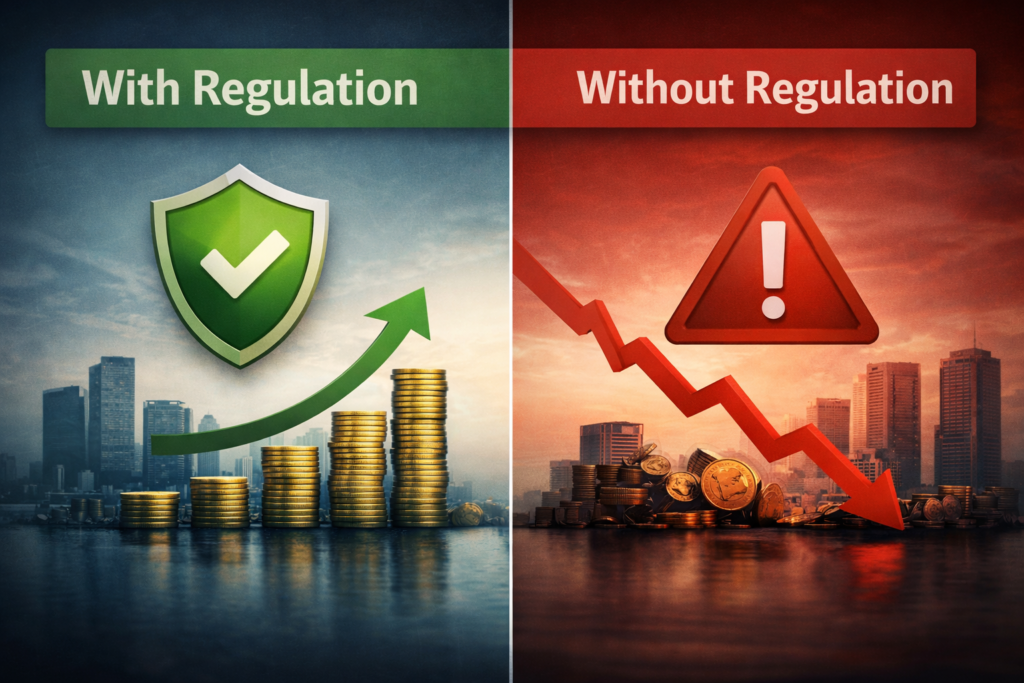
IV. Regulated vs. unsupervised: the most real gap
We look at it in the most direct way:
| Dimensions | No regulation | It's regulated. |
|---|---|---|
| Client trust | Low | High |
| Size of funds | Small master | Big money. |
| Conversion Efficiency | Slow | Quick |
| Market development | Limited | Expand |
It's not "a little lift,"
It's about "deciding whether you can do it big."
Why are more and more platforms starting to regulate?
As competition in the market increases, users become more rational:
They don't just look at the profits anymore.
But it's more about:
Compliance of the platform
Queryable
Is it real or not?
As a result, a growing number of platforms have started to layout:
US SEC (Investment Adviser / Private Collection)
United States MSB (funds and payments compliance)
UK FCA (High Trust Regulation)
Australia ASIC
Singapore MAS (Asian Core Regulation)
👉 Regulation, which is becoming an industry frame.
VI. If you're experiencing these problems
If your platform is facing:
Clients are late in taking money.
The conversion rate is falling.
It's getting more and more expensive.
Then you need to rethink:
The problem may not be traffic.
It's your compliance base.
VII. SOLUTIONS: ENHANCING YOUR CONTROL SYSTEM
We provide global financial licensing and compliance solutions covering:
SEC / MSB / FCA / ASIC / MAS
Support for:
The official system is accessible.
<unk> Quick processing
♪ One-hand resource match ♪
Full process compliance support
VIII. ACCESS TO YOUR COMPLIANCE PROGRAMME NOW
If you want:
Increased client trust
Attracting higher-quality funding
Getting the platform into a real growth phase
Now, we can get an exclusive solution.
IX. Common issues
Q1: Is there any regulation that can serve as a financial platform?
There is very limited room for development, especially at the level of customer trust and funding.
Q2: How long does it take to regulate?
According to different countries, the general cycle varies from 2 to 8 weeks.
Q3: What's the difference between SEC and MSB?
This is the first time that the European Commission (SEC) has been involved in investment advisers and fund-raising compliance.
The MSB is mainly concerned with financial services and payment-related operations.
Q4: Which regulation is best suited for brokers?
Common options include: FCA, ASCIC, MSB, based on business model.