
At an early stage, many financial platforms tend to focus on systems development, business interfaces, transactional functions, account opening links and market promotion.
But when the platform really begins to face clients, channels, institutional partners and funding sources, a real problem will emerge:
Clients will not only see whether your products are usable, but will also see whether your company is credible, funds secure and business is on a compliance basis.
In the financial sector, trust is never built on a “we are safe” line, but rather from a searchable, verifiable and demonstrable regulatory structure.
regulatory licences are becoming the first trust threshold for the financial platform.
For foreign exchange platforms, digital asset platforms, fund management companies, investment advisers, payment service providers and financial science and technology enterprises, the value of regulatory licences is more than a “certification of compliance”.
It's more like a basic ticket to the market.
When clients first approach a financial platform, they usually focus on several core issues:
Is this company real?
Is there publicly available regulatory information?
Is there a clear business entity?
Are there compliance documents and risk disclosures?
Is it worth investing funds or establishing long-term cooperation?
If these questions cannot be answered clearly, it is difficult to truly build trust with a better system, a lower level of weakness and a higher level of revenue.
Without a regulatory basis, the platform is vulnerable to growth bottlenecks
Many financial enterprises find that advertising can generate flows at an early stage, but they may not translate into customers.
The real change rate is often not page design, nor client rhetoric, but the most critical sentence in the client's mind:
"Is this platform safe or not?"
If the Platform lacks regulatory information, corporate access, compliance instructions and clear business structures, clients hesitate.
In particular, high net value clients, institutional clients, channel agents and long-term funding do not focus solely on advocacy, but on the legal subjects behind the platform, regulatory pathways and risk control capabilities.
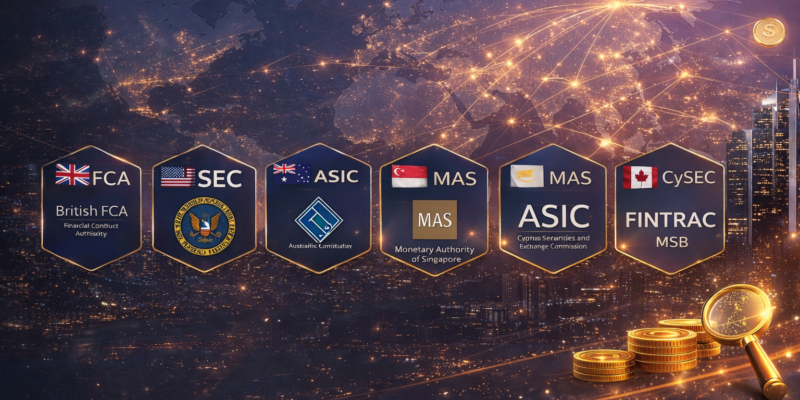
This is why a growing number of financial platforms have begun to set up international regulatory systems, such as SEC, MSB, FCA, ASIC, MAS, FINTRAC.
The value of being regulated, not just "looks formal"
Many companies mistakenly thought that the regulatory licence was only to be displayed online, which was a very shallow understanding.
The true value of regulation is expressed in three ways:
First, improve client trust.
Publicly accessible regulatory information can reduce the client ' s psychological defence and make clients more willing to know about the platform, register accounts, submit information or enter into next communication.
Secondly, the capacity for business cooperation should be enhanced.
Many payment corridors, institutional cooperation, traffic channels, technical service providers and overseas partners require the Platform to provide corporate documents, regulatory information, business descriptions and compliance materials before cooperating.
Thirdly, the long-term value of the brand is enhanced.
A platform with regulatory structures would make it easier to upgrade from a general project to an internationalized financial brand rather than staying in short-term client and price competition.
The appropriate regulatory path is different for different types of business
When the financial platform chooses to regulate the license, it cannot simply look at which license is “sounding high”, but it depends more on the matching of its business type.
For example:
Investment advisers, asset management and fund consulting operations usually focus on US SEC/RIA orientation.
Money services, digital assets and cross-border payments-related operations usually focus on the United States of America, MSB, Canada FINTRAC, etc.
Companies wishing to build a higher international financial brand might focus on such regulatory systems as the United Kingdom FCA, Australia ASIC, Singapore MAS, Cyprus CySEC.
Where financing, securities issuance, RWA or STO structures are involved, further design in the context of a securities regulatory framework is needed.
Thus, regulation is not simply “buying a license”, but planning as a whole according to business models, customer markets, payment needs, brand positioning and future development paths.
The clearer the oversight information, the faster the client makes decisions.
In the financial sector, the biggest fear among clients is the lack of transparency in information.
If a platform is able to present clearly in the official network the subject of the company, regulatory instructions, access, risk disclosure, scope of service and compliance documentation, the confidence-building rate of the client will increase significantly.
Regulatory information has become an important part of the turnover of the network, especially in the areas of foreign exchange, digital assets, funds, payments and cross-border financial services.
A professional network of financial platform officials should not simply display product functions, but rather allow clients to see:
Who are you?
What kind of supervision are you under?
How do clients check?
Is the business legally compliant?
How are funds and risks managed?
Why should I trust you?
These are often more persuasive than exaggerated marketing slogans.
Competition in the future financial platform is essentially a competition in the trust system
Markets are becoming more mature and customers are becoming more rational.
In the past, the platform could rely on high returns, low thresholds and strong outreach for quick access.
However, clients are now more concerned with security, transparency, regulatory context and long-term stability.
For financial enterprises that really want to develop in the long term, regulatory licences are not a cost, but an infrastructure.
It helps the platform build confidence, improves transaction rates, expands resources for cooperation and enables enterprises to qualify for greater market access.
Financial platforms that can move further in the future are often not the most aggressive ones to advocate for, but rather the ones with clearer regulatory structures, a stronger business base and greater customer trust.