Many of the financial platforms are operating with a very typical problem:
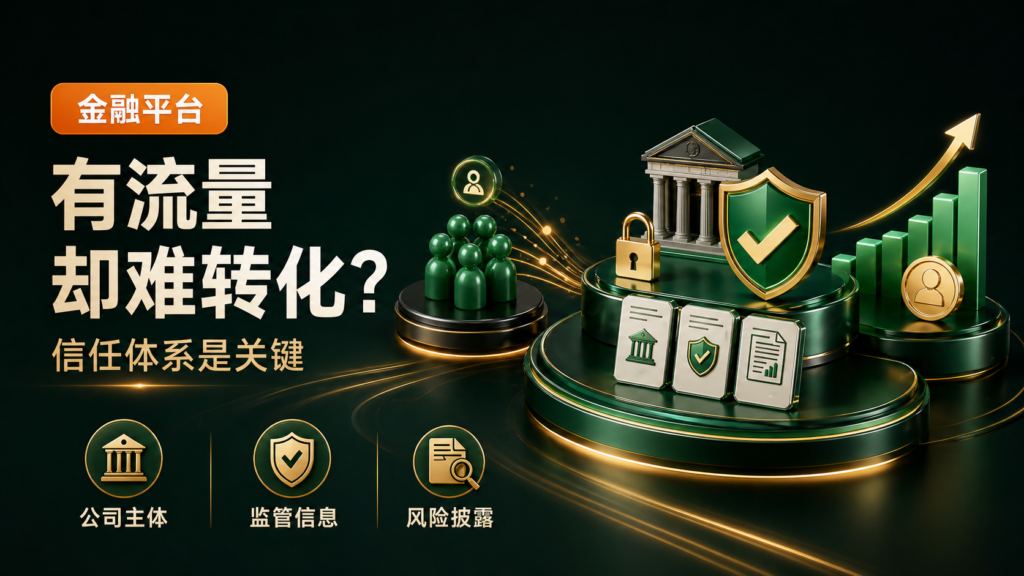
Advertising is on the air, websites are accessed and social media are exposed, and client counselling appears to be low, but few people are really willing to open accounts, make money, cooperate or enter the next line of communication.
On the face of it, it's not good.
In the financial sector, however, the real influence on transformation is often not the flow itself, but the first reaction of the client after contact with the platform:
"Is this platform worth trusting?"
If clients do not see clear corporate subjects, regulatory information, compliance statements, risk disclosure and financial security logic in a short time, it is difficult to make more traffic effective.
I. Financial sector transformation, essentially trust transformation
Common products can be procured by relying on prices, functions, activities and experiences.
But the financial platform is different.
Whether it is a foreign exchange platform, a digital asset platform, a fund service provider, a payment platform or an investment adviser-type operation, clients judge safety before making decisions.
Clients do not only care about the poor quality of the pages, but also about the size of the preferential activities.
They are more concerned:
Is the company behind the platform real?
Is the regulatory information clear?
Is there a searchable licence or compliance information?
Is the rules for access payments transparent?
Is risk disclosure complete?
Are there basic safeguards for the security of client funds and accounts?
If these questions are not answered, the client hesitates.
Once the client has begun to hesitate, the deal becomes very difficult.
High traffic does not mean that clients are willing to make deals.
Many platforms would classify the problem as “inadequate flow” or “inadequate follow-up of the customer service”.
The reality, however, is that, even if the clients themselves have needs, the rate of conversion will remain low if the platform lacks credibility.
When clients enter the official network, they usually quickly browse through several priority areas:
The first page contains any information on regulation and compliance;
About whether our page clearly describes the company ' s background;
Whether the regulatory number or official query entry can be seen;
Whether privacy policies, service provisions, risk tips exist;
(b) Whether client funds security, AML/KYC, account protection etc. are available;
Whether the page as a whole resembles a long-term platform rather than ad hoc projects.
These elements determine whether the client is willing to continue to understand them.
If the website focuses on transactional functions, revenue opportunities, low margins or rapid opening of accounts without being supported by trust, customers are vulnerable to leakage before critical steps are taken.
III. Inadequate systems of trust that can lead to inefficient access to the platform
Platforms without a trust system usually have several problems:
(b) Advertisements were heavily hit, but the quality of the consultation was not high;
Clients repeatedly asked whether the company was formal;
The customer service needs to be constantly explained on security issues;
(b) The requests from the channel partners for additional information on companies and regulations;
No further action was taken by the client after the site was read;
Low conversion rates make it more difficult to repurchase and to work together in the long term.
This suggests that the problem does not necessarily arise at the extension end, but that the confidence structure that may emerge from the platform is not in place.
The financial platform does not simply attract customers to make a deal.
The real key is for clients to quickly form a judgement within minutes of entering the site:
The platform is subject, regulated, ruled, risk-control conscious and worthy of continued communication.
IV. What should a complete system of confidence be built into?
A financial platform that is more accessible to clients, usually requires several core modules.
First, the company's subject is clear.
The network should clearly demonstrate the business name, registered area, operational location and range of services, so that clients know who is behind the platform.
Second, regulatory information can be validated.
Where the Platform has relevant controls, plates or compliance filing information, it should provide clear descriptions and official search routes to the extent possible, and reduce the cost of customer verification.
Thirdly, compliance documents are complete.
Privacy policies, service terms, risk disclosure, anti-money-laundering policies, customer protection statements, etc., while not necessarily the first to be read by clients, may affect the professionalism and credibility of the Platform.
Fourthly, risk statements are transparent.
The more mature the platform, the more risky the financial business is, the more it is, rather than focusing on gains and advantages.
Fifthly, the page is uniform.
From the front page, about us, about regulatory information, about services, to the foot of the page, all content should be presented in a consistent branding that allows clients to see a complete, stable and professional financial services system.
V. Supervised plates are not decorations, but a trust entrance
Many platforms consider that the regulatory licences are simply on the website to enhance their image.
But a truly effective regulatory display is not simply a name or picture, but an information structure that customers can understand and validate.
For example:
Who is the supervisory authority;
What is the applicable range of operations;
How customers can consult;
What is the relationship between corporate subjects and platform brands?
Which services are regulated and which require risk alerts;
How the platform maintains compliance operations on a continuous basis.
The clearer this information becomes, the easier it is for clients to build trust.
The more trust the customer, the smoother the transformation path.
Future financial platforms are “reliability assets”
The financial sector is moving from a heavy-handed to a competitive phase of trust.
In the past, the Platform could rely on advertising, outreach and activities to stimulate rapid access to clients.
But now, clients are more cautious, information verification capabilities are stronger, and the security and compliance of the platform are more demanding.
A truly competitive platform for the future is not just the one with the highest volume of traffic, but rather the one that can transform flows into trust, into a deal, and into a long-term relationship.
For financial enterprises, regulatory information, compliance documentation, risk disclosure, corporate ownership and customer protection mechanisms are no longer ancillary to the website, but rather the long-term growth of the platform ' s infrastructure.
The flow is truly valuable when a system of trust is in place.