For enterprises planning to carry out currency exchange, cross-border remittance, money transfer or related money services in Hong Kong, China, the Hong Kong MSO Money Service Operators' License is one of the important regulatory licences.
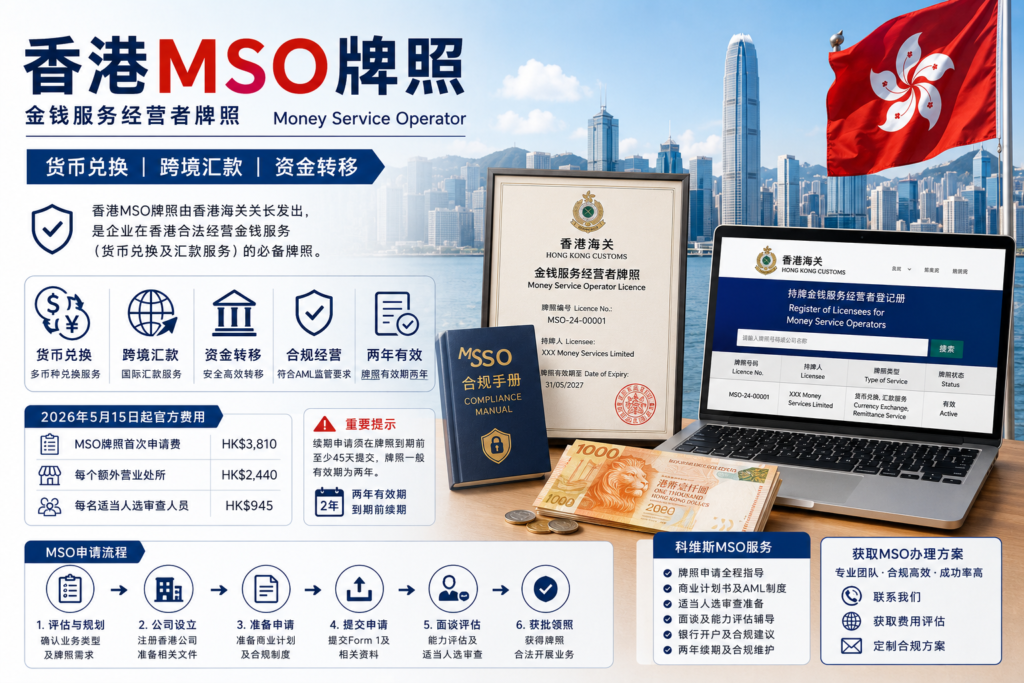
The full English name of the MSO is:
Money Service Operator
The official Chinese name is normally:
Money service operators.
The Hong Kong MSO license is issued by the Hong Kong Customs and Excise Director for the approval, supervision and enforcement of the Money Laundering and Terrorist Financing Ordinance.
The core business for which MSO licences are required includes, inter alia:
- Money-changing services;
- Money remittance services;
- Money exchange and remittance services are also available.
MSO in Hong Kong is not a bank licence and is not equivalent to an electronic currency licence or a payment agency licence.
The type of service, the place of business, the business plan and the business model approved by the Hong Kong Customs Service shall be the basis for the business that a licensed enterprise can perform.
Before applying, enterprises need to make clear that:
- Is it a currency exchange or is it a simultaneous remittance;
- (b) Whether to establish a physical shop;
- Whether they operate online or without a designated establishment;
- (b) Which banks or channels through which the customer ' s funds flow;
- (c) Whether to cooperate with institutions that transfer remittances abroad;
- The shareholders, directors and ultimate owners meet the requirements for suitable candidates;
- Have business plans and AML/CFT systems been prepared;
- The ability to actually carry out monetary services is available.
Assessing the MSO license in Hong Kong?
The COVIS may assist in making a preliminary determination of the conditions of application, the costs and the project preparation programme by submitting your type of service, financial flows, business model and shareholder structure.
I. What is the Hong Kong MSO license?
According to the Hong Kong Money Laundering and Terrorist Financing Ordinance, anyone wishing to operate a money service in Hong Kong generally needs to obtain a MSO licence issued by the Hong Kong Customs Service.
The so-called “money services” include, inter alia:
1. Currency exchange services
Exchanges between different currencies in the form of operations, such as:
- Hong Kong currency for United States dollar exchange;
- (b) The renminbi for the exchange of Hong Kong currency;
- Foreign currency exchange in euros, yen, etc.;
- (b) Foreign currency exchange for individuals or enterprises;
- Currency conversion related to remittance operations.
There may be legal exemptions for currency exchange activities that are partly ancillary to the services of hotels, retailers or other subjects, but must be judged by the particular business, and it cannot be assumed on its own that no application is required.
2. Remittance services
One or more of the following services are provided in the form of operations:
- Remittance of funds out of Hong Kong;
- (b) Receiving remittances from outside Hong Kong;
- (a) Arrange for the transfer of funds outside Hong Kong;
- (b) Arrange for the receipt of funds from abroad;
- The transfer of funds is effected through banks, agents or other channels.
Typical business scenarios include:
- International remittances;
- Cross-border payments by enterprises;
- Vendor settlement;
- Remittances of tuition fees or living expenses abroad;
- Remittances of salaries;
- Cross-border transfer of funds by businesses.
Official sources:
Hong Kong Customs Service: Money Service Operators License Guide
Laws of Hong Kong: Money Laundering and Terrorist Financing Ordinance, Chapter 615
II. Hong Kong MSO pays for licenses?
MSOs in Hong Kong are mainly used to regulate currency exchange and remittance activities and should not be simply understood as covering all payment operations with a combined payment licence.
MSOs can normally be used to assess the following:
- Currency exchange;
- International remittances;
- (b) Transfer of funds;
- (b) Cross-border arrangements for receiving payments;
- Currency conversion associated with remittances.
However, MSO cannot automatically cover:
- Bank deposits;
- Electronic wallet storage value;
- (b) The distribution of the value payment tool;
- Bank account services;
- Portfolio investment;
- Asset management;
- Virtual asset trading platform;
- Credits and loans;
- Issuance of credit cards or bank cards;
- Unrestricted business billing.
If an enterprise plans to operate an electronic wallet, prepaid balance or storage value payment tool, further assessment of the value payment instrument system under the supervision of the Hong Kong Financial Authority may be required.
If virtual asset exchange or trading platforms are involved, the Hong Kong Securities and Futures Supervisory Commission or other relevant regulatory requirements will also need to be assessed.
Therefore, the more precise positioning of MSO is:
Hong Kong currency exchange and remittance service plates are not generic payment plates applicable to all financial technology operations.
III. Which enterprises are suitable to apply for MSO in Hong Kong?
Money-changing companies
Foreign currency exchange services are provided to individuals or enterprises under the entity ' s doors or other approved modalities.
2. International remittance enterprises
Helping clients to transfer funds from Hong Kong to other countries or regions or to receive funds from abroad.
3. Cross-border commercial payment platforms
For business clients:
- Vendor payments;
- (b) International trade payments;
- (b) Cross-border payment of wages;
- Enterprise cost settlement;
- Multi-currency payment arrangements.
4. Remittance agents and channel providers
(c) To cooperate with offshore banks, money transfer agencies or payment enterprises in order to receive customers, receive information and arrange cross-border transfers in Hong Kong.
5. Financial technology remittance platforms
Completed through a website or application:
- Client opening;
- (b) Identification;
- Exchange rate quotations;
- Directive on remittances;
- (a) Transaction status queries;
- Electronic record-keeping.
Even if a customer is not received at a fixed-door place, the applicant is usually required to maintain a local management office and bookkeeping location in Hong Kong.
IV. Which operations are not necessarily suitable for applying for MSO alone?
The following business cannot simply be covered by MSO plates:
- operating banks or receiving public deposits;
- Issuance of electronic wallets for storage value;
- (b) Provide portfolio investment or asset management;
- Operation of a virtual asset trading platform;
- Providing leverage for foreign exchange investment transactions;
- (c) Operating credit card receipts;
- (a) Loans;
- Provision of insurance products;
- There is no real business to obtain a public licence number.
If an enterprise only provides purely technical services, for example:
- Exchange rate information;
- SaaS software;
- Communications interface;
- Data transmission;
- Technical platform without access to client funds;
It would be necessary to judge whether a contractual relationship, financial control and actual services constituted a remittance service.
What is the official application fee for MSO in Hong Kong in 2026?
The Hong Kong Government adjusted the MSO licence application and renewal fees in 2026, and the new fees are from 15 May 2026 Entry into force.
First license application fee
| Cost items | Costs effective 15 May 2026 |
|---|---|
| MSO licence first application fee | HK$3,810 |
| Every extra place. | HK$2,440 |
| Reviewers per suitable candidate | HK$945 |
For example, one company applied for a major establishment and had:
- Two directors;
- (a) An ultimate owner;
All three are subject to a proper candidate review, and the official base costs are expected to be:
- (a) Licence application fee: HK$3,810;
- Three personnel review fees: HK$ 2,835;
- Total: HK $6,645.
If there is another branch or additional place of business, the HK$2,440 is added.
Extension of licence costs
| Cost items | Costs effective 15 May 2026 |
|---|---|
| MSO renewal fee | HK$910 |
| Every extra place. | HK$410 |
| Reviewers per suitable candidate | Based on the latest fee advice |
Official expenses do not include:
- Hong Kong company registration;
- Business registers;
- (b) Company secretary;
- Entity offices;
- Local managers;
- Business plans;
- AML/CFT system;
- (a) Bank opening;
- IT and trading systems;
- Professional consultancy services;
- Ongoing compliance maintenance.
Official sources:
Hong Kong Customs Service: MSO licence adjustment bulletin 2026
Hong Kong Customs MSO licensing system: updated circular
How much is it going to cost to run MSO in Hong Kong in 2026?
There is no uniform professional service price for the MSO project in Hong Kong.
The actual budget usually depends on:
- (b) Whether to apply for currency exchange or for simultaneous remittance;
- (a) Whether Hong Kong companies already exist;
- Number of shareholders and ultimate owners;
- Whether there are complex offshore equity structures;
- Whether or not to use a physical shop;
- Whether to use an online or undesignated business model;
- Have offices been rented;
- Whether a bank account exists;
- Whether offshore money transfer cooperation agencies exist;
- Whether an AML/CFT system is in place;
- Whether operational systems and staff training are required;
- Completeness of application.
COVIS integrated project reference budget
| Type of project | Integrated reference budget |
|---|---|
| Standard currency exchange MSO project | USD 25,000 – 40,000 |
| Currency exchange and remittance portfolio project | USD 35,000-$60,000 |
| Cross-border remittances online and multi-share structure | USD 50,000 – 80,000 |
| Multi-country channels, complex financial flow projects | USD 70,000-120,000 |
| Include banks, systems and complete operations | USD 100,000-180,000 or more |
These are the commercial reference budgets of COVIS, which are based on the complexity of the project and the scope of services, and are not official prices established by the Hong Kong Customs.
Integrated services may include:
- (a) Assessment of the applicability of the MSO;
- Establishment of a Hong Kong company;
- (b) Stockholding and eventual ownership organization;
- Business model planning;
- Recommendations for the organization of the entity ' s premises or local management offices;
- Business plans;
- Description of financial flows;
- Documentation of banking and offshore cooperation in the transfer of funds;
- AML/CFT policy;
- (b) The customer identification system;
- Client risk rating;
- Sanctions screening process;
- (b) The suspicious transactions system;
- (a) The design of the duties of the compliance officer and MLRO;
- Form 1 and subsidiary information preparation;
- (b) A statement of suitable candidates;
- (a) Interviews and capacity assessment preparation;
- Hong Kong Customs Supplementary Assistance.
If the applicant already has a Hong Kong company, a suitable office, a bank account, a mature team and a complete AML system, the actual service programme may be lower than the public budget mentioned above.
Access to cost assessment for MSO in Hong Kong
The type of service submitted, the number of shareholders, the business model and the flow of funds could be further assessed.
VII. Do Hong Kong MSO have minimum registered capital requirements?
The Hong Kong MSO licensing system does not provide for a uniform fixed minimum capital for all applicants.
But this does not mean that the business can have insufficient operating funds.
The Hong Kong Customs Department, in its proper selection and application preparation assessment, will be concerned about the applicant ' s financial resources available to carry out its proposed business and ensure that the financial position of the enterprise does not compromise the interests of the client and the public.
An enterprise usually needs to demonstrate its ability to pay:
- (b) The cost of setting up a company;
- Rent and deposits;
- (a) Remuneration of employees;
- Compliance personnel;
- (b) Bank and remittance channel costs;
- KYC and the trading monitoring system;
- Accounting and auditing;
- At least initial operating costs.
The applicant also requires reasonable justification for:
- Source of funds;
- (a) The expected volume of transactions;
- Māori and exchange rate income;
- Operating expenses;
- (a) The initial deficit budget;
- Whether client funds are separated from corporate funds;
- How to ensure that remittances are completed in a timely manner.
Therefore, the Hong Kong MSO could not be promoted as a “zero-capital-ready payment licence”.
VIII. What are the personnel to be included in the review of suitable candidates?
If the applicant is a company, the persons normally required to be reviewed by a suitable candidate include:
- (a) Each director;
- (a) Each final owner;
- Other applicable control personnel in connection with money service operations.
The Hong Kong Customs Service will check whether the person concerned:
- (a) Has been involved in money-laundering or terrorist financing offences;
- Has been involved in fraud, embezzlement or dishonesty;
- (b) Continuing violations of anti-money-laundering legislation;
- (a) belong to an unsolved person;
- (a) In relation to clearance or taking over proceedings;
- Having poor regulatory records;
- Good faith and reliability;
- (a) Adequate financial soundness;
- You really understand and plan to run the MSO business.
The proper candidate review is not limited to the submission of passports and addresses.
Hong Kong Customs may check:
- Hong Kong and overseas criminal records;
- Regulatory penalties;
- Company history;
- Financial position;
- (a) Sanctions records;
- Applications for past-licensing licences;
- The authenticity of the information requested.
Official sources:
Hong Kong Customs Service: Guidelines for the evaluation of suitable candidates
Hong Kong Customs Service: Statement of application for suitable candidates
IX. Do applicants need to participate in a competency assessment?
Need.
The Hong Kong Customs Service requires qualified applicants or holders to participate in the competency assessment.
In general, eligible persons include:
- (b) Independent operators;
- Partners;
- The director of the company.
The assessment usually involves:
- Hong Kong MSO licensing system;
- Anti-money-laundering and counter-terrorism financing obligations;
- Customer due diligence;
- Record-keeping;
- Treatment of suspicious transactions;
- Sanctions and proliferation financing risks;
- High-risk customer management;
- Continuous compliance responsibilities of licensed institutions.
The competency assessment is one of the factors that the Hong Kong Customs Department determines whether the applicant is fit to operate a money service.
Applications may be rejected if the applicant does not nominate eligible persons as required, does not participate in the assessment or fails to demonstrate basic compliance capacity.
Official sources:
Hong Kong Customs Service: Guidance for MSO Competency Assessment Candidates
X. What are the requirements of the Hong Kong MSO for the establishment?
The applicant may choose:
- (b) Operating monetary services at designated premises;
- In the absence of a designated place of business, the presence of the Hong Kong entity is still required.
Operated in a designated location
Hong Kong Customs usually assesses:
- The availability of premises for inspection by customs officials;
- (a) Whether there are fixed, clear and non-temporary signs;
- Is the business ready internally;
- (a) Whether it is located in a building suitable for commercial use;
- Compliance with building deeds and usage requirements;
- Client reception, data-keeping and operational conditions.
Applications are usually made with photographs of the place of business and outside it.
Operating without a designated establishment
MSOs, online or non-storey, still need to be maintained in Hong Kong:
- Local management offices;
- (a) The books and places where the records are kept;
- (b) The physical location of the entities available for inspection by the Hong Kong Customs;
- Local presence able to manage operations and maintain information.
The Hong Kong Customs Service explicitly requires that online operations do not mean that there can be no physical office in Hong Kong at all.
Place of deposit of book records
Applicants are required to provide Hong Kong books and places where records are kept and to maintain complete information on transactions in money services.
The site should:
- Controlled by a licensed institution;
- (b) The ability to maintain complete business records;
- (b) Access to Hong Kong Customs;
- (b) Facilitating regulatory inspection;
- The address of the mailbox, which is not capable of storing information, cannot be used.
What are the requirements for bank accounts?
The Hong Kong Customs Department will follow up on the applicant ' s bank accounts used to operate money services.
The applicant is usually required to provide:
- (a) Certificate of the holder of the bank account;
- Information on accounts issued by banks;
- The bank has knowledge that the account will be used for money service operations or the relevant certificate;
- Description of the use of the funds in the account;
- Client funds and corporate funding arrangements;
- (a) The route of payment outside the country;
- Information on the counterparty or money transfer agency.
Bank accounts used for business purposes shall normally be held in the name of:
- The applicant company;
- (b) Independent operators;
- The applicable director, partner or ultimate owner, with full explanation.
The Hong Kong Customs iPASS application preparation list explicitly mentions that the applicant is required to provide proof of ownership of the bank account and confirmation that the bank is aware of the use of the account for money services.
It is often difficult to prove that the business is ready to operate with a licence but without a bank or remittance channel that can be used in practice.
XII. What does the AML/CFT system of MSO in Hong Kong require?
Applicants are required to submit written anti-money-laundering, counter-terrorism financing and counter-proliferation financing systems that match the actual operations.
The system should normally include:
Enterprise risk assessment
The following risks are assessed:
- Client type;
- National and regional;
- Products and services;
- (b) Channels of trade;
- Cash transactions;
- Non-face-to-face clients;
- High-risk countries;
- Agents and intermediaries;
- Cross-border financial pathways.
2. Customer due diligence
Including:
- Personal identification;
- (b) Corporate customer certification;
- (a) The beneficial owner is identified;
- (a) The purpose of the business relationship;
- Source of funds;
- Sources of wealth;
- Representative authority;
- Ongoing client review.
3. Enhanced scrutiny of high-risk clients
For example:
- (b) Political figures;
- Clients in high-risk countries;
- Complex corporate structures;
- Large cash clients;
- Unusual remittances;
- Transactions for which there is no explicit economic purpose.
4. Sanctions and terrorist financing screening
Business needs to establish:
- United Nations Sanctions List screening;
- screening of terrorist lists;
- (b) Proliferation financing risk control;
- Suspension and reporting processes after the hit list;
- Ongoing re-screening mechanism.
5. Control of transactions
Identification:
- (b) Disrupting transactions;
- (b) Unusually frequent remittances;
- (b) Rapid access to funds;
- Multiple remittances to the same recipient;
- Transactions incompatible with the client ' s profession or business;
- High-risk area funding flows.
6. Suspicious transaction reports
Establish internal reporting, investigation, recording and reporting procedures to the Joint Financial Intelligence Unit.
7. Record-keeping
Proper preservation:
- Customer identity information;
- (b) Transaction records;
- Bank and payment certificates;
- Due diligence information;
- Suspicious transaction investigation records;
- Internal approval documents;
- Staff training records.
8. Compliance Officer and MLRO
An enterprise needs to be empowered to:
- Compliance Officer;
- Money Laundering Reporting Officer。
Hong Kong Customs may consider suspending or revoking the licence if the licensed institution is unable to maintain the qualified compliance officer or MLRO on a continuous basis.
Official sources:
Hong Kong Customs Service: MSO Anti-Money Laundering and Counter-Terrorism Financing Guidelines
Hong Kong Customs: MSO Application Preparation Assessment iPASS
XIII. What information is required to prepare an application for MSO in Hong Kong?
Company information
- Hong Kong company registration certificate;
- Business registers;
- (a) The charter of the company;
- (b) Shareholders ' lists;
- Roster of directors;
- Registration address;
- Main business addresses;
- Group structure;
- Associated company information;
- The final owner's data.
Shareholders, directors and ultimate owners
- Hong Kong identity card or passport;
- (a) Address certificate;
- Biographical information;
- Shareholding ratio;
- Control relationships;
- Business and financial background;
- Certification of criminal record;
- (a) Insolvency and statement of action;
- (b) Regulatory records;
- Source of funding.
Information on the place of business
- Lease agreements;
- (a) The owner consents to the document;
- Site plan;
- Internal and external photographs;
- (a) Sign photographs;
- Certification of commercial use;
- (b) Information on the location of the books of account;
- Locally managed office information.
Operational information
- Business plans;
- Type of service;
- Target clients;
- Client countries;
- (a) The expected volume of transactions;
- The expected amount of the transaction;
- Fees patterns;
- Exchange rate income;
- (a) Financial flow maps;
- (a) Bank accounts;
- (b) Offshore money transfer agencies;
- (b) Channels of payment;
- (b) Agency or cooperation agreements;
- IT system description.
Compliance information
- AML/CFT/CPF system;
- Enterprise risk assessment;
- The KYC procedure;
- (a) The beneficial owner is identified;
- Client risk rating;
- Sanctions screening system;
- Rules for the control of transactions;
- Reporting procedures for suspicious transactions;
- (b) Record-keeping systems;
- (b) Staff training programmes;
- Compliance officer and MLRO information.
XIV. Hong Kong MSO complete processing process
Step 1: Assess whether MSO licences are required for operations
Confirming whether the enterprise is operating:
- Currency exchange;
- Remittances;
- A combination of the two;
- Whether or not any statutory immunity applies.
Step two: defining business models
Organisation
- (b) The establishment of the designated entity;
- There are no designated premises but local management offices are maintained in Hong Kong;
- (a) On-line or off-line customer services;
- (a) Cash or non-cash operations;
- Co-operation in the transfer of remittances through own channels or third parties.
Step 3: Establishment of a Hong Kong company
_Other Organiser
- (a) Company registration;
- Business registers;
- Equity structure;
- (b) Board arrangements;
- Final owner confirmation.
Step 4: Preparation for business and record-keeping
Arrangements:
- (a) A door or office;
- Local management offices;
- (a) The location where the books of account are kept;
- (a) Signs and operating facilities;
- Leases and owners agree to documents.
Step 5: Opening of business bank accounts
The bank is prepared to do all it can and to inform the bank that the account will be used for money-service operations.
Step 6: Identification of offshore cooperation agencies
If cross-border remittances are involved, the following needs to be organized:
- Banks;
- Money transfer agencies;
- (a) Payment platforms;
- (b) Agents;
- (b) Liquidation bodies;
- Channels for the delivery of funds.
Step 7: Preparation of business plans
Note:
- Business model;
- Client type;
- Service areas;
- (a) Financial flows;
- (b) The fee structure;
- (a) The expected volume of transactions;
- Staffing;
- Risk control;
- System arrangements.
Step 8: Development of the AML/CFT system
Based on operational readiness risk assessment, KYC, monitoring, reporting and record-keeping procedures.
Step 9: Submission of Form 1 and subsidiary information
Submission of applications, business plans and AML policies through the Hong Kong Customs and Excise MSO licensing system or by designation.
Step 10: Submission of a statement of suitable candidates
Directors, final owners and other applicable persons are referred to Form 3A or Form 3B.
Step XI: Payment of official fees
After confirmation of the material, the Hong Kong Customs Department issues a notice of contribution.
Step XII: Participation in interviews and capacity assessment
The eligible director or applicant is required to participate as required.
Step XIII: On-site inspection
Hong Kong Customs may inspect:
- (b) Establishments;
- Local management offices;
- (a) The location where the books of account are kept;
- (a) Signs;
- Systems;
- Actual operational readiness.
Step XIV: Responses to additional questions
The applicant may need to add:
- Bank certificates;
- (b) Agreements with cooperating institutions;
- (a) Financial flows;
- Shareholders ' background;
- (a) Location information;
- AML system;
- Customer risk management.
Step 15: Getting MSO plates
Once approved, the enterprise may operate within the type and location of the approved service.
Official sources:
Hong Kong Customs Service: MSO Licensing Guide
Hong Kong Customs Service: MSO licence application form
How long does it normally take to get to MSO in Hong Kong?
The Hong Kong Customs Service does not have a fixed approval cycle for all applications.
The actual project time depends mainly on:
- Company and equity information;
- (b) The appropriate candidate background;
- Preparation of premises;
- (a) Bank accounts;
- (b) Cooperation in the transfer of remittances abroad;
- Business plans;
- AML system;
- Interviews and competency assessments;
- On-site inspection;
- Quickness of response to supplementary information.
From the perspective of full project planning, reference can be made to:
| Type of project | Comprehensive reference cycle |
|---|---|
| Fully documented currency exchange projects | 4-7 months |
| Standard exchange and remittance projects | 6-10 months |
| Online cross-border remittance projects | 8-12 months |
| Multi-State channels or complex shareholder projects | 10-15 months or more |
This is a practical planning reference and is not a time frame for clearance imposed or guaranteed by the Hong Kong Customs.
XVI. How long will the Hong Kong MSO license be valid?
Hong Kong MSO plates are generally valid:
Two years.
Holders need to apply for renewal before the licence expires.
The guidelines for Hong Kong Customs Licenses state that renewal applications are to be submitted at least 45 days before the expiration of the licence; customs usually send a notice about 90 days in advance.
The renewal usually requires resubmission of:
- Form 2;
- Supplementary information forms;
- Statement of suitable candidates;
- Updated business plan;
- Updated AML policy;
- Information on the place of business;
- Relevant supporting documentation.
The licensed institutions may also need to participate again in the capacity assessment.
Failure to submit a valid renewal within the statutory deadline automatically lapses upon expiration of the original licence and the enterprise must cease its business of monetary services.
17. What are the continuing maintenance requirements after holding a licence?
After the approval of the MSOs in Hong Kong, it is usually necessary to carry out the following:
- (a) Maintaining real business;
- (b) Maintaining Hong Kong operations or management offices;
- (a) Keep the complete books of account;
- (b) Maintaining the qualified directors and ultimate owners;
- Maintenance of compliance officers and MLRO;
- (b) The ongoing implementation of the AML system;
- Update enterprise risk assessment;
- Completion of staff training;
- (b) Ongoing client review;
- (b) Keep records of transactions;
- Submission of suspicious transaction reports;
- (a) To submit periodic reports on time;
- Reporting changes in company information;
- Application for new directors or final owners;
- (b) Applications for new premises;
- Rescheduled on time.
Hong Kong Customs may suspend or revoke a license for the following reasons:
- No longer meet the requirements for suitable candidates;
- (a) Failure to maintain an operating or management office;
- (a) Periodic reports are not submitted on time;
- (b) No real financial services have been carried out;
- Violation of anti-money-laundering legislation;
- The eligibility of CO or MLRO was not maintained.
Can Hong Kong MSO serve its clients worldwide?
The fact that a business can provide remittance services in all countries of the world cannot be assumed solely by the Hong Kong MSO licence.
The enterprise also needs to assess the location of its client:
- Permits for payment and transfer of remittances;
- Cross-border marketing rules;
- Exchange control;
- Consumer protection;
- Data and privacy rules;
- Anti-money-laundering requirements;
- Restrictions on the entry and exit of funds.
Hong Kong MSO plates cannot automatically replace:
- MTL at the state level, USA;
- Canada FINTRAC MSB;
- EMI or PI, United Kingdom;
- EU EMI;
- Singapore MAS payment licence;
- Australia ' s remittance or financial authorization;
- Local payments regulation in other countries.
Cross-border remittance projects often also require cooperation with licensed banks, money transfer agencies or payment service providers in the target countries.
What difference does Hong Kong MSO make to Canada's MSB?
| Comparative items | Hong Kong MSO | FINTRAC MSB Canada |
|---|---|---|
| Regulatory bodies | Hong Kong Customs | FINTRAC |
| Legal nature | Licence to operate money services | Federal anti-money-laundering registry |
| Core business | Currency exchange, remittances | Exchange, remittance, virtual currency, etc. |
| Official application fees | Yes. | Registration itself is usually free. |
| Validity of license | Usually two years. | Usually two years. |
| Place of business | Requires physical presence in Hong Kong | Based on MSB or Foreign MSB |
| Capacity assessment | Participation of applicable personnel | No uniform examination in the same form |
| Virtual currency | MSO cannot automatically overwrite | Registerable virtual currency services |
| Open Query | Hong Kong Customs Register | FINTRAC registry |
Enterprises should choose the regulatory path based on target markets, financial flows, client areas and types of business, and not just cost comparisons.
XX. Common problems of MSO in Hong Kong
1. Can non-Hong Kong residents apply for MSO?
An assessment can be made.
It is not necessary that all shareholders and directors be permanent residents of Hong Kong, but enterprises need to have local operating and regulatory arrangements that can be effectively regulated by the Hong Kong Customs.
2. Do Hong Kong companies have to be registered?
Most enterprise projects will use the Hong Kong company as the subject of the application.
Individuals and forms of partnership may also apply, but corporate structures are usually more suitable for cross-border remittance operations.
3. Do Hong Kong MSO have minimum capital requirements?
There is no single fixed minimum capital for all applicants, but the applicant needs to demonstrate sufficient financial resources and real operational capability.
4. Can MSO exchange the renminbi?
Assessments may be made on the basis of the scope of operations, banking arrangements and applicable foreign exchange and cross-border financial rules.
Can MSO operate online?
The online model can be evaluated, but there is still a need to maintain local management offices and bookkeeping locations in Hong Kong.
6. Can MSO receive cash?
Cash can be processed under the approved business model, but cash operations are usually exposed to higher money-laundering risks and stricter control requirements.
7. Can MSO operate electronic wallets?
An electronic wallet of the value of the reserve cannot be issued on the sole basis of MSO plates, and separate monitoring of the payment instrument for assessing the value of the reserve is required.
8. Can MSO make virtual currency exchange?
MSO licences do not automatically cover virtual asset transactions, hosting or platform operations.
9. Do banks have to open accounts once MSO is acquired?
No guarantee.
Banks independently audit shareholders, client countries, financial flows, AML systems, scale of transactions and cooperation agencies.
10. Can the application be guaranteed?
Can't.
The final decision is taken by the Hong Kong Customs Service on the basis of the applicant ' s operations, personnel, premises, funds, systems and suitable candidates.
11. Can licences be purchased or transferred?
The company ' s shareholdings may be traded in accordance with the law, but the new directors and ultimate owners usually require prior approval from the Hong Kong Customs Service and cannot be bypassed by the appropriate candidates through the acquisition company.
12. Where do you look for the license of the Hong Kong MSO?
The following can be consulted in the Hong Kong Customs and Customs System:
- Name of the holder;
- (a) The number of the licence;
- Business address;
- (a) The status of the licence;
- _Other Organiser
Official Query Entry:
Hong Kong Customs Service: Register of licensed money service operators
COVIS Hong Kong MSO application for services
COVIS may assist in:
- (a) Assessment of the applicability of MSO in Hong Kong;
- Classification of currency exchange and remittance operations;
- Establishment of a Hong Kong company;
- (b) Stockholding and eventual ownership organization;
- (a) Physical planning of business premises;
- Local management of office and record location arrangements;
- Business plans;
- (b) Customer funds flow design;
- Bank and offshore money transfer agencies;
- AML/CFT/CPF system;
- Enterprise risk assessment;
- KYC and client risk rating;
- Sanctions screening system;
- The suspicious transaction processing process;
- (b) The design of the duties of the compliance officer and MLRO;
- Form 1 and information preparation for suitable candidates;
- Capacity assessment and preparation for interviews;
- Additional response from Hong Kong Customs;
- Extension of licences and ongoing compliance planning.
Access to the Hong Kong MSO processing programme
If the enterprises already have Hong Kong companies, offices, bank accounts, money remittance partners and a complete compliance system, the actual service programme may be lower than the present public consolidated budget.
The following information is submitted for preliminary assessment:
- (b) The provision of money-changing or remittance services;
- (a) Whether to use a physical shop;
- (b) Whether to receive customers online;
- (a) The country in which the client is located;
- (b) The receipt of cash;
- Whether Hong Kong companies exist;
- The existence of banks and remittance channels;
- Number of shareholders, directors and ultimate owners.
Source and official link
1. Application for and continuing request for a licence of MSO in Hong Kong
Hong Kong Customs Service: Money Service Officials Licensing Guide
2. Hong Kong Monetary Services Regulatory Law
Laws of Hong Kong: Money Laundering and Terrorist Financing Ordinance, Chapter 615
3. MSO licence cost adjustment for 2026
Hong Kong Customs: Fee Reviews under the MSO Licening Regime
4. Criteria for the evaluation of suitable candidates
5. MPO capacity assessment statement
Customs Notes on the Commission Association for MSOs
6. MSO Business Plan and AML System Guidance
Hong Kong Customs Service: MSO Guidelines
7. MSO application form and change form
8. MSO application preparation assessment
Hong Kong Customs Service: MSO iPASS
9. MSC updated regulatory circulars
Hong Kong Customs: Customs to Money Service Officials
10. Publicly licensed MSO queries
Hong Kong Customs: Customs of Hong Kong for Money Service Officials
Price description
The consolidated budget of US$ 25,000-180,000 is presented here as a commercial reference budget of COVIS based on the business model, equity structure, financial flows and range of services.
The budget is not an official processing price established by the Hong Kong Customs and does not represent a single offer from all market services.
The following items will normally need to be calculated separately or in combination:
- Hong Kong company registration;
- Business registers;
- (b) Company secretary;
- (a) The entity operates or manages the office;
- (b) Official applications and personnel review costs;
- (a) The compliance officer and MLRO;
- (a) Bank accounts;
- (b) Channels of cooperation in the transfer of remittances abroad;
- KYC and the trading monitoring system;
- Accounting and auditing;
- Ongoing compliance and two-year renewal.
The final cost would need to be determined on the basis of the type of service provided by the applicant, the number of places, the number of suitable candidates, the country of operation and the material available.
Disclaimer
This paper is intended for general information purposes only and does not constitute a legal opinion, regulatory approval commitment, bank opening guarantee or investment proposal in Hong Kong.
Hong Kong MSO licences are applied mainly to currency exchange and remittance services and do not equal bank, storage value payment instruments, securities or virtual asset plates.
Before a firm formally carries out a currency exchange, remittance or cross-border transfer of funds, it should conduct a targeted legal and compliance assessment based on actual operations, client areas, financial flows and the latest regulatory requirements.