
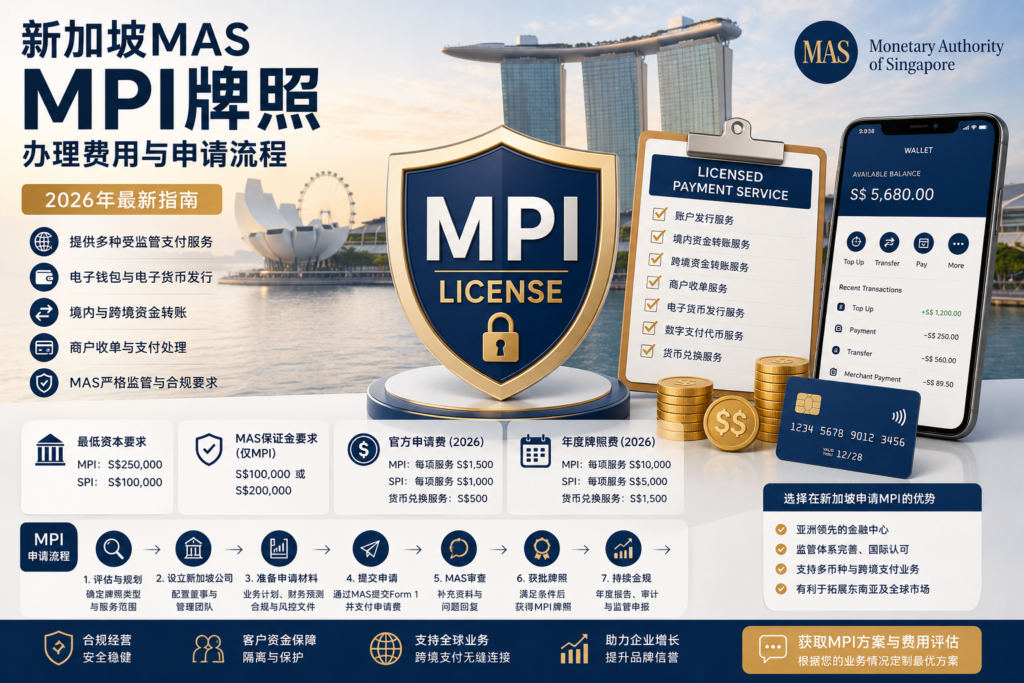
For enterprises planning to operate cross-border payments, electronic wallets, business receipts, internal transfers, digital payment tokens or electronic money operations in Singapore, the MAS payment agency licence of the Singapore Finance Authority is one of the important regulatory paths.
The full name of the MAS is:
Monetary Authority of Singapore
Singapore Payment Services Act 2019 has three main types of payment service plates:
- Money-Changing Licence, currency exchange licence;
- Standard Payment Establishment, standard payment agency licence, short SPI;
- Major Payment Integration Limited, main payment agency licence, known as MPI.
Of these, MPI is suitable for an enterprise that is expected to have larger transactions, that has operations above the SPI scale threshold, or that wishes to establish a more complete system of payment services.
It should be noted that MPI is not a bank licence and does not mean that licensed enterprises can carry out any form of financial business.
The specific services that an enterprise can operate depend on the type of payment services approved by the MAS, the business model and the licensing conditions.
An assessment of Singapore's MAS license?
The COVIS may assist in making a preliminary determination as to whether the application is suitable for SPI or MPI by submitting your payment product, the flow of funds, the customer area and the size of the expected monthly transaction.
I. What is the MAS MPI of Singapore?
MPI's full English name is:
Major Payment Institution
The Chinese language is commonly known as:
- (b) Main payment agencies;
- Large payment agencies;
- Singapore MPI pays licences;
- MAS is the main paying agency licence.
MPI is supervised by the Singapore Finance Authority MAS under the Payment Services Act 2019.
Compared to SPI, MPI may continue to provide approved payment services beyond the threshold of the size of the transaction assigned by the standard payment institution.
MPI usually has to assume more complete regulatory obligations, including:
- Minimum capital requirements;
- Maintenance of a bond to MAS;
- (b) Financial security for clients;
- Anti-money-laundering and counter-terrorism financing;
- Technology risk management;
- (b) Cybersecurity;
- Regular regulatory reporting;
- (b) Independent audits;
- Client complaints processing;
- (a) Reports of major incidents;
- Continuous compliance with the requirement of appropriateness.
Official sources:
MAS:Licensing for Payment Service Providers
Singapore Statutes Online:Payment Services Act 2019
II. What business can Singapore pay license cover?
Singapore ' s regulatory framework for payment services mainly covers the following seven categories of payment services.
1. Accounts issuance services
This includes issuing payment accounts to customers or operating accounts used to execute payment transactions.
Common scenarios include:
- Electronic wallets;
- (a) Payment accounts;
- Mobile payment accounts;
- (a) An account for prepaid balances;
- Platform user payment accounts.
2. Internal funds transfer services
Financial transfer services are provided for transactions where the payer and the recipient are located in Singapore.
Common scenarios include:
- Local transfers in Singapore;
- Transfers between electronic wallets;
- Local business payments;
- (b) The bulk payment by the enterprise;
- Local payment processing.
3. Cross-border funds transfer services
Services for cross-border payments, receipts or transfers of funds.
Common scenarios include:
- International remittances;
- (b) Cross-border payment of wages;
- Cross-border payments by enterprises;
- Vendor payments;
- (a) International receipts;
- Money transfers.
4. Commercial billing services
Payments are accepted and processed for the business and the related amounts are settled with the business.
Possible involvement of:
- (b) Electrician receipts;
- (b) Underline business receipts;
- (a) The payment gateway;
- (a) Compromise payments;
- (b) Settlement of business funds;
- Two-dimensional code payment.
Electronic money distribution services
Issuance can be used to pay for the electronic storage of transactions.
Possible involvement of:
- E-barrel balances;
- Reserve value accounts;
- (a) Prepaid products;
- (a) Digitalized balance of payments;
- E-money can be redeemed.
6. Digital payment token services
(b) Possible cases involving the payment of digital tokens:
- Sale;
- Exchange;
- Transfer;
- (b) Arrange for transfers;
- (b) Trusteeship;
- (a) The enforcement of client directives;
- Related transaction services.
Digital payment token operations face additional anti-money laundering, customer asset protection and technical risk requirements.
Currency exchange services
Legal currency exchange services are provided through entities or other authorized modes.
An enterprise may not have to apply for all seven types of services.
The scope of application should be determined on the basis of the real business of the enterprise, the flow of funds and the functionality of the product.
Official sources:
Singapore Statutes Online:Payment Services Act 2019 First Schedule
III. What difference does it make between MPI and SPI?
Both SPI and MPI can provide payment services according to the scope of approval, mainly on the basis of the size of the operation and the continuous regulatory requirements.
SPI standard payment agency
SPI applies to payment service providers whose transaction size is below the specified threshold.
The main size thresholds currently presented by MAS include:
- The average monthly transaction value for a single paid service does not exceed S$ 3,000,000;
- (b) The combined average monthly transaction value of two or more payment services does not exceed S$6,000,000;
- No more than S$5,000,000 is paid for electronic currency.
The manner in which the different services are calculated and the items excluded may differ and should be judged on the basis of the specific services of the enterprise.
MPI main payment agency
If an enterprise exceeds the applicable SPI threshold, it will normally need to apply for or convert to MPI.
MPI does not have the same trade size ceiling as SPI, but will bear higher:
- Capital requirements;
- (b) Guarantee requirements;
- The client ' s financial security responsibilities;
- Regulatory reporting obligations;
- Audit and risk management responsibilities.
SPI and MPI Core Distinction
| Comparative items | SPI | MPI |
|---|---|---|
| Full name | Standard Payment Institution | Major Payment Institution |
| Applicable size | Below the specified threshold | Beyond SPI threshold or large operations |
| Minimum capital | S$100,000 | S$250,000 |
| MAS Bond | MPI security requirements are not normally applied | $100,000 or $200,000 |
| Financial security of clients | Based on service and applicable rules | More complete safeguards are usually applied |
| Fees for applications | Based on service, usually S$1,000 per unit | Based on service, usually S $1,500 per unit |
| Annual fee | Usually, it's S$5,000 apiece. | Usually, it's S$10,000 each. |
| Size of operations | Limited volume of transactions and size of electronic currency | Not subject to SPI ceiling of the same size |
Official sources:
MAS:Licensing for Payment Service Providers
Singapore Statutes Online:Payment Services Regulations 2019
IV. Which enterprises are suitable to apply for MAS MPI?
1. Cross-border payment companies
International remittances, cross-border payments and multi-currency transfers are provided to enterprises or individuals.
2. Electronic wallet platform
Users are allowed to refill, save balances, transfer to other users or make payments to businesses.
3. Commercial billing agencies
Helps businesses to accept bank cards, 2D codes, electronic wallets or other means of payment and to complete their settlement.
4. Financial science and technology payment platform
Accounts, payments, transfers, receipts and fund management functions are provided through applications or websites.
5. B2B corporate payment platform
Provide business with:
- Vendor payments;
- (a) Batch payments;
- Cross-border settlements;
- Wage payments;
- Enterprise cost management;
- Accounts receivable management.
6. Electronic money issuers
The electronic storage value or wallet balance that can be used for payment by third parties is issued to clients.
7. Digital payment token enterprises
Provide exchange, transfer, transaction or hosting services that meet Singapore ' s definition of digital payment currency regulation.
8. Enterprises expected to quickly exceed the SPI threshold
Some of the projects, although initially small in scale, show that the SPI threshold will be exceeded more quickly, allowing for a direct assessment of the MPI path and avoiding subsequent re-applications for change of licences.
V. Which enterprises do not necessarily need MPI?
The following items do not necessarily require a direct application for MPI:
- (b) The scale of the transaction is long below the SPI threshold;
- (b) Provide purely technical systems only;
- Not receiving or controlling the funds of the client;
- (b) Processing payments only for companies in the same group;
- (a) Only sells their own goods or services;
- (a) The operation meets limited network or other exclusions;
- Only software interfaces are available;
- Only company-owned funds are paid;
- It only operates abroad and does not provide services to Singaporean customers.
Some enterprises may be better suited to:
- SPI standard payment institutions;
- Money-Changing Licence;
- (a) Agent or partner of the regulated paying institution;
- Technical service providers;
- Commercial model for the application of exemption arrangements.
The need for a licence, which cannot be judged solely on the basis of the business name, should be analysed according to the following factors:
- Who receives funds from clients;
- Who controls the funds;
- Who pays the payee;
- Where the customer is located;
- Whether the transaction took place in Singapore;
- Whether enterprises are engaging the public in Singapore;
- How enterprises charge fees.
What is the minimum capital of MAS MPI in Singapore in 2026?
Applications for and continued possession of MPI plates usually require maintenance of at least:
S$250,000 in capital.
The basic capital requirements of SPI are usually:
S$100,000。
If the subject of the application is a foreign company, the corresponding headquarters net funding requirements are to be met in accordance with the regulations.
The minimum capital is not the application fee paid to MAS, nor is it the service fee charged by COVIS.
It is the regulatory capital that the applicant needs to hold.
Businesses also need to prove that:
- (a) The existence of capital;
- (a) The legal origin of the funds;
- (a) Not client funds;
- (b) Not part of the unexplainable temporary borrowing;
- (a) Be sustainable;
- Additional operating funds are available;
- Financial projections match capital.
An enterprise cannot simply prepare S$250,000 to consider that the requirements for a full application are in place.
The actual project will also need to be reserved for:
- (b) Salaries of personnel;
- Offices;
- Technical systems;
- Compliance system;
- Legal and audit services;
- (b) Financial security for clients;
- Bonds;
- Banks and the costs of cooperation.
Official sources:
Singapore Statutes Online: Payment Services Studies 2019, Regulations 8 and 12
MAS:Guidelines on Licensing for Payment Service Providers
VII. How much bond does MPI have to pay to MAS?
MPI is required to maintain a guaranteed amount of the specified amount.
There are currently two main levels:
S$100,000 deposit
If, during the current calendar year, an enterprise receives, processes or executes a monthly average sum of no more than:
S$6,000,000
The S$100,000 deposit is normally required.
S$200,000 deposit
MPIs that do not meet the lower transaction volume conditions described above usually need to be maintained:
S$200,000 deposit.
The bond may be through the applicable requirements:
- Cash deposits;
- Bank guarantees;
- Other means accepted by MAS;
Arrangements to be made.
An enterprise needs to consider:
- S$250,000 minimum capital;
- (b) S$100,000 or S $200,000 bond;
- Adequate operating funds.
Official sources:
Singapore Statutes Online:Payment Services Regulations 2019,Regulation 13
What is the official application fee for the MAS MPI for the year 8-2026?
The MAS application fee is not a flat fixed S $15,000, but is calculated on the basis of the type of license requested and the amount of services paid.
SPI application fee
For most supervised services, the SPI application fee is usually:
Every S$1,000.
Currency exchange services are usually:
S$500。
In multi-service applications, the cost of the account issuance service may be zero, but the minimum costing rule still needs to be met for the overall application.
MPI application fee
For most supervised services, MPI application fees are usually:
S $1,500 each.
Currency exchange services are usually:
S$500。
In multi-service applications, account issuance services may not be costed separately, but the total application fee should be determined in the aggregate manner in the legislation.
Example of application fee
If an enterprise applies for MPI and applies for the following three services:
- Cross-border transfer of funds;
- (b) Commercial billing;
- Electronic currency issuance;
The official application fee may be:
S$1,500 × 3=S$4,500。
A further increase of S$500 is possible in the case of simultaneous requests for currency exchange.
MAS application fees are normally not refundable.
If the application is withdrawn or not approved, the application fee paid will not normally be refunded.
Official sources:
Singapore Statutes Online:Payment Services Regulations 2019 Fee Schedule
MAS:How to Apply for a Payment Service Provider Licence
Nine, what is MPI's annual official license fee?
The MPI and SPI are required to pay the annual licence fee when approved.
SPI annual licence fees
For most of the services paid, the annual SPI costs are usually:
S $5,000 each.
Currency exchange services are usually:
S$1,500。
MPI annual licence fees
For most paid services, MPI annual costs are usually:
S $10,000 each.
Currency exchange services are usually:
S$1,500。
For example, one MPI was allowed to provide:
- Cross-border transfer of funds;
- (b) Commercial billing;
- Electronic currency issuance;
The annual official licence fee may be:
S$10,000 × 3=S$30,000。
The costs for the year in which the licence is obtained are normally prorated to the number of days from the date of approval to 31 December of the year.
The annual licence fee does not include:
- Audit;
- Compliance team;
- AML system;
- Technical systems;
- (a) Bank accounts;
- (b) Financial security for clients;
- Professional consultants;
- Office and staff costs.
Official sources:
Singapore Statutes Online:Payment Services Regulations 2019 Fee Schedule
How much is it gonna cost to run the MAS MPI in 2026?
There is no uniform commercial service price for the Singapore MAS payment licence.
The actual budget depends primarily on:
- Application SPI or MPI;
- Number of applications for payment services;
- (b) Whether electronic currency is issued;
- Whether digital payment tokens are involved;
- Whether or not to serve retail customers;
- (a) Whether or not the client funds are held;
- (a) The country in which the client is located;
- Shareholders and control person structures;
- Whether Singapore companies exist;
- (b) The existence of local management teams;
- Whether payment technology systems exist;
- Whether there is a banking and security institution programme in place;
- Completeness of existing compliance documents.
COVIS integrated project reference budget
| Type of project | Integrated reference budget |
|---|---|
| Standard SPI application project | USD 150,000-220,000 |
| Standard MPI payment agency application | USD 250,000-380,000 |
| Multi-payment services and cross-border operations MPI | USD 320,000-500,000 |
| Electronic currency, complex financial flows MPI | USD 400,000-650,000 |
| Digital payment tokens or integrated financial technology projects | Over $500,000 – $800,000 |
The above amounts are part of the integrated business reference budget of COVIS, which is based on the full range of project services, and are not an official application fee for MAS, nor do they include regulatory capital and bonds.
The integrated projects may include:
- Assessment of the applicability of licences;
- Comparison of SPI and MPI paths;
- Analysis of types of payment services;
- Singapore Corporate and Equity Structure Planning;
- Recommendations for local directors and management arrangements;
- Business model and flow of funds;
- Business plans;
- Three-year financial projections;
- AML/CFT system;
- (b) The customer identification process;
- Sanctions screening system;
- (a) The client ' s financial security policy;
- Technical risk management document;
- Cybersecurity policy;
- Business continuity plan;
- Outsourcing management system;
- Form 1 request preparation;
- MAS response assistance;
- Ongoing compliance planning after approval.
If the enterprise already has a mature management team, a payment system, a banking cooperation programme and partial compliance documentation, the actual service programme may be lower than the public consolidated budget.
Access to MAS MPI cost assessment
The actual project costs can be further assessed by submitting information on the type of services paid, the flow of funds, the size of monthly transactions and the team.
XI. What are the conditions to be met in applying for MAS MPI?
1. Appropriate Singapore applicant
The applicant usually needs to:
- Companies incorporated in Singapore;
- Or a foreign company that completes its registration in Singapore.
The applicant must have a permanent place of business or registered office in Singapore.
The location should be able to support:
- Operations management;
- Regulatory communication;
- Client complaints processing;
- Maintenance of company records;
- Operational.
The mere provision of an address that does not support a real business is often insufficient to demonstrate that the enterprise has the capacity to operate in Singapore.
2. Fulfilment of directorships
The applicant usually requires at least one Executive Director to be:
- Singapore citizens;
- Or permanent residents of Singapore.
Where applicable conditions are met, the following may be used:
- (a) A non-executive director of a citizen or permanent resident of Singapore;
- Add an executive director with a Singapore Employment Permit;
and the combination arrangement.
The final director structure needs to be confirmed in accordance with the current application form and the MAS requirements.
Appropriate shareholders and controlling persons
MAS reviews:
- Direct shareholders;
- (a) The ultimate beneficial owner;
- (a) The person in actual control;
- Directors;
- Chief Executive Officer;
- Key management staff.
The review will normally include:
- Integrity;
- (a) The reputation;
- Financial soundness;
- Relevant experience;
- (b) Regulatory records;
- (b) Record of offences and proceedings;
- Sources of finance and wealth;
- Capacity to operate payment operations.
4. Clear and viable business model
Business needs to state:
- (a) What payment services are provided;
- Who's the customer?
- (a) The countries in which the customer is located;
- How to receive funds;
- How to transmit and settle;
- (b) Whether electronic currency is issued;
- (a) Whether or not the client funds are held;
- How to collect the fees;
- How to access customers;
- Which banks and cooperation institutions are used.
5. Experienced management team
Common core positions include:
- Chief Executive Officer;
- Executive Director;
- (b) The compliance officer;
- (b) The person responsible for combating money-laundering;
- Risk managers;
- (b) Financial Officer;
- (b) The head of technical and information security;
- Operator.
MAS will be concerned about whether managers have experience in payment, banking, financial science and technology, compliance or risk management.
6. Complete risk and compliance systems
The applicant enterprise is required to establish a business risk matching:
- AML/CFT system;
- (a) Customer identification;
- Client risk rating;
- Sanctions screening;
- (b) Control of transactions;
- Suspicious transaction reports (STR);
- Fraud risk control;
- Client complaints processing;
- Technology risk management;
- (b) Cybersecurity;
- Business continuity;
- Outsourcing management;
- Record-keeping system.
XII. How do MPI clients need to be assured of their funds?
MPI usually needs to complete its financial security in accordance with the applicable rules when it receives or controls funds related to its clients.
Common approaches may include:
- (a) To secure the commitment of full responsibility of qualified safeguards bodies;
- (b) To obtain guarantees from a qualified safeguard body;
- (b) Depositing the relevant client funds in an independent trust account;
- Other safeguards approved by MAS.
Enterprises should ensure that:
- (a) Separation of client funds from company-owned funds;
- Clear identification of the funds account;
- Regular reconciliation of funds;
- (b) The manner in which disclosure is secured in the customer ' s agreement;
- (b) Ongoing evaluation of the institution;
- (b) Keep relevant records;
- Client funds can be identified in the event of an enterprise ' s insolvency.
Digital payment token service providers may also need to deposit customer digital payment token assets in appropriate fiduciary arrangements and implement a more complete system of customer asset protection, in accordance with existing rules.
Official sources:
Singapore Statutes Online:Payment Services Act 2019,Section 23
Singapore Statutes Online: Payment Services Studies 2019, Studies 14-18J
XIII. What information is required to prepare an application for MAS MPI?
Corporate and equity information
- (a) Certificate of incorporation of the company;
- (a) The charter of the company;
- (b) Shareholders ' lists;
- Roster of directors;
- Group structure;
- Information on the ultimate beneficial owner;
- Associated company information;
- Data on registered offices;
- Information on the physical location of the office;
- Shareholders ' sources of funds and wealth.
Information on directors and managers
- (a) Passport or identification;
- (a) Address certificate;
- Biographical information;
- Education and professional qualifications;
- Experience in the payment industry;
- Compliance and risk experience;
- (a) The body or bodies previously in office;
- (b) Regulatory and disciplinary records;
- (b) Job duties;
- Time input statement.
Operational information
- Business plans;
- Product description;
- Type of payment service;
- Client type;
- Target countries;
- Fees patterns;
- (a) The expected monthly volume of transactions;
- (a) The projected fund balance of the client;
- (a) Financial flow maps;
- Client opening process;
- (a) The process of filling, payment and cash withdrawal;
- Banks and payment partners;
- Third-party technical service providers;
- Market extension programme.
Financial information
- (a) Initial capital certification;
- Source of funds;
- Three-year financial projections;
- Income and cost assumptions;
- Cash flow forecasting;
- Pressure testing;
- (b) Operating financial arrangements;
- Guarantee arrangements.
Compliance information
- AML/CFT policy;
- (b) Customer identification procedures;
- Client risk rating;
- Sanctions screening;
- (b) Control of transactions;
- Suspicious transaction reports (STR);
- Fraud risk management;
- (a) The client ' s financial security policy;
- (b) The complaints handling system;
- Outsourcing management policy;
- (b) Record-keeping policy;
- Compliance monitoring plan.
Technical and information security information
- System architecture;
- Data flow maps;
- User access control;
- (b) Cybersecurity systems;
- Incident response plan;
- Data backup;
- Disaster recovery;
- Occupancy tests;
- Management of technical service providers;
- Business continuity plan.
XIV. MAS MPI COMPLETE PROJECTS
Step 1: Conduct a licence applicability analysis
Determines whether the business constitutes a regulated payment service and whether there is exclusion or exemption.
Step 2: Determine SPI or MPI
The type of licence is selected based on the expected volume of transactions, electronic currency balances and business development plans.
Step 3: Determination of the range of paid services
Confirmation of need:
- (a) The issuance of accounts;
- Internal transfers;
- Cross-border transfers;
- (b) Commercial billing;
- Electronic currency issuance;
- Digital payment tokens;
- Currency exchange.
Step 4: Establishment and restructuring of Singapore companies
Completion of company, equity, directorship and location arrangements.
Step five: Configure the core management team
Identification of chief executive officers, executive directors, compliance, AML, risk, finance and technical staff.
Step 6: Flow of funds and business processes
Draws a process for opening, filling, paying, transferring, clearing, refunding and cash withdrawals of clients.
Step 7: Prepare capital and bonds
Ensure that enterprises have:
- MPI minimum S250,000 base capital;
- (b) S$100,000 or S $200,000 bond;
- Sufficient initial operating funds.
Step 8: Preparation of application documents
Preparation of business plans, financial projections, compliance systems, technical information and client fund security programmes.
Step 9: Submission of Form 1 and official fees
The application for payment of service licences is submitted by way of designation by the MAS and the corresponding application fee is paid.
Step 10: under MAS review
MAS may ask questions about:
- Business model;
- (a) Shareholders ' sources of funding;
- Management team experience;
- Client countries;
- (a) Financial flows;
- (a) The regime against money-laundering;
- Technical systems;
- (b) Financial security for clients;
- (a) Financial projections;
- Bank cooperation;
- Outsourcing arrangements.
Step XI: Supplementary and modified materials
Supplementary information was submitted and the application documents adjusted in accordance with MAS ' comments.
Step XII: Pre-approved conditions
Possible include:
- Capital is in place;
- Guarantee arrangements;
- (b) Staff on duty;
- Office readiness;
- Systems testing;
- (b) Client funds security accounts;
- Final policy approval.
Step 13: Getting a license and starting business
Once approved, the enterprise should operate within the limits of its licence and implement its ongoing regulatory obligations.
How long does it normally take to get to the MAS MPI?
MAS does not commit to a single fixed approval cycle for all payment licence items.
The actual time depends on:
- (a) The level of operational complexity;
- Number of services requested;
- Whether digital payment tokens are involved;
- Equity structure;
- Management team;
- (a) Completeness of the document;
- Source of funds;
- Technical systems;
- Banking and safeguard arrangements;
- MAS question speed of response.
From the perspective of full project planning, reference can be made to:
| Type of project | Comprehensive reference cycle |
|---|---|
| SPI projects with simpler operations | 8-12 months |
| Standard Payment Operations MPI | 10-16 months |
| Multi-service or electronic currency MPI | 12-20 months |
| Digital payment tokens and complex cross-border projects | 15-24 months or more |
These are practical references to the project and are not the approval periods set or guaranteed by the MAS.
Any propaganda claiming that “weeks of guaranteed access to MAS MPI plates” should be carefully verified.
XVI. What is required for ongoing maintenance following approval of the MAS MPI?
Once the licence is obtained, the enterprise will need to continue to complete:
- Maintaining minimum capital;
- Maintenance of the bond;
- (b) Financial security for clients;
- AML/CFT continuous monitoring;
- Sanctions screening;
- Suspicious transaction reports (STR);
- Regulatory data declarations;
- Annual audit;
- (a) Financial statements;
- Technology risk management;
- (b) Cybersecurity testing;
- Staff compliance training;
- Client complaints processing;
- (a) Reports of major incidents;
- (b) Approval for changes in shareholders and control;
- Directors and senior managers ' change approvals;
- Requests for changes in the scope of operational services;
- Annual licence fees are paid.
If the licensed institution is authorized to perform multiple services but does not perform a partially approved service within six months of being granted, it may need to apply for removal of the unperformed service in accordance with the applicable rules.
Can MAS MPI serve global customers?
The Singapore MPI licence alone cannot be used to conclude that a company can provide payment services in all regions of the world.
The Singapore licence primarily addresses the licensing of enterprises under Singapore ' s payment regulatory framework.
If an enterprise serves a client in other countries, it also needs to assess:
- Local payment of licences;
- Rules on cross-border remittance;
- (b) Electronic currency rules;
- Digital asset rules;
- Consumer protection;
- (b) Cross-border data;
- Marketing and outreach restrictions;
- Anti-money-laundering requirements.
MPI can help enterprises to establish Singapore ' s payers, but cannot automatically replace:
- MTL at the state level, USA;
- EMI, United Kingdom;
- EU EMI or PI;
- Hong Kong SVF or MSO;
- Permits are paid in other regions.
What difference does it make between MAS MPI and EMI?
| Comparative items | MAS MPI Singapore | UK FCA EMI |
|---|---|---|
| Main regulatory bodies | MAS | FCA |
| Key regulatory frameworks | Payment Services Act | Electronic Money Regulations |
| Scope of operations | Multiple payment services | Electronic currency and payment services |
| Minimum capital | S$250,000 | AEMI Minimum €350,000 |
| Whether electronic currency must be issued | Not necessarily. | One of EMI's core business |
| Bonds | $100,000 or $200,000 | There is usually no same form of MAS security. |
| Main markets | Singapore and Asia Operations Layout | The British market. |
| Cross-border traffic | Do not automatically cover other countries | Do not automatically overwrite the EU |
| Regulatory focus | Payments, AML, technology and client funds | Electronic currency, payments and financial security |
Enterprises should select jurisdictions according to the target market, product type, customer funding model and development plan.
XIX. What circumstances make MPI applications difficult?
Common problems include:
- Lack of clarity in the business model;
- (a) The payment services could not be accurately classified;
- The source of the shareholders ' funds cannot be verified;
- Lack of payment experience for managers;
- Local directors are merely named;
- Singapore is not operational;
- (a) Inconsistencies between business plans and technology systems;
- (b) Lack of clarity on the client ' s financial flows;
- (a) Incomplete banking cooperation programmes;
- (c) The inability of clients to secure funds;
- Financial projections are overly optimistic;
- (a) The use of a generic template for the AML system;
- High-risk countries account for a higher percentage of clients;
- (b) Insufficient control over digital asset risk;
- Overshoring of critical functions;
- (b) The inability to effectively monitor third-party service providers;
- Misdirected publicity on the company ' s website;
- The only way to get a license is to get a license for commercial endorsement.
The MAS is not concerned with the number of applications, but with whether the enterprise is truly capable of operating a payment operation in a safe, robust and continuous manner.
xx. Common problems of MAS MPI
1. Can non-Singapore residents apply for MPI?
An assessment can be made.
Foreign shareholders may participate in Singapore companies, but directors and local regulatory arrangements need to meet existing regulatory requirements.
2. Must there be a Singapore company?
The applicant usually needs to be a company incorporated in Singapore or a foreign company that completes its registration in Singapore and has a permanent place of business or registered office in Singapore.
3. Is S250,000 a fee?
Nope.
It belongs to the MPI minimum base capital and is held by the applicant ' s own enterprise.
4. Can a deposit replace minimum capital?
No way.
The minimum capital is a different requirement from the S$100,000 or S $200,000 deposit.
Can MPI make cross-border remittances?
This can be done after authorization has been granted for cross-border money transfer services.
6. Can MPI issue electronic wallets?
It can be provided within the corresponding licences, such as the issuance of accounts and electronic currency.
7. Could MPI conduct a digital asset transaction?
The corresponding operations can only be carried out after obtaining the powers of digital payment of token services and meeting the additional regulatory requirements.
8. Could MPI issue a bank card directly?
Businesses are often required to cooperate with card organizations, issuing institutions, banks or other regulated partners, and cannot automatically connect to the banking card network by simply using MPI.
9. Do banks have to open accounts after obtaining MPI?
No guarantee.
Banks independently audit shareholders, client countries, financial flows, AML systems, size of operations and technical systems.
10. Is the MPI application guaranteed?
Can't.
The final decision is made by MAS based on the business, shareholders, capital, team, technology and compliance capabilities of the enterprise.
11. Does MPI need an annual audit?
Payment agencies are required to complete audit and regulatory reports in accordance with applicable regulations, depending on the licence and the operation.
12. Is MPI transferable?
The company's shareholding may change according to law, but a major stockholding, control, directorship or management change may require the prior approval of the MAS and may not be freely traded as a common commodity.
COVIS Singapore MAS MPI Application for Service
COVIS may assist in:
- MAS Payment Licence Applicability assessment;
- Comparison of SPI and MPI paths;
- (a) Classification of seven categories of payment services;
- Singapore Corporate and Equity Structure Planning;
- Recommendations for local directors and management teams;
- Business plans;
- Three-year financial projections;
- Financial flows and business process design;
- AML/CFT policy;
- KYC and client risk rating;
- Sanctions screening and control of transactions;
- (a) The client ' s financial security policy;
- Technical risk management document;
- Network security and business continuity plan;
- Outsourcing management system;
- Form 1 request preparation;
- MAS response assistance;
- Ongoing compliance planning after approval.
Get MAS MPI processing
If the enterprise already has a mature payment system, a management team, banking cooperation and partial compliance documentation, the actual service option may be lower than the present public consolidated budget.
The following information is submitted for preliminary assessment:
- Planned payment services;
- (a) The estimated monthly amount of the transaction;
- Whether to issue electronic wallets or reserve value balances;
- Whether digital payment tokens are involved;
- (a) The country in which the client is located;
- (b) Whether to receive and control client funds;
- Whether Singapore companies are currently in existence;
- Whether there are banks or paying partners.
Source and official link
1. MAS Payment Service License Type
MAS:Licensing for Payment Service Providers
2. MAS Payment Licence application process
MAS:How to Apply for a Payment Service Provider Licence
3. Updated guide to payment service provider licensing
MAS:Guidelines on Licensing for Payment Service Providers
4. Application form for payment of service plates
MAS:Form 1 – Application for a Payment Service Provider Licence
Singapore Payment for Services Act
Singapore Statutes Online:Payment Services Act 2019
6. Capital, bonds, application fees and annual fees
Singapore Statutes Online:Payment Services Regulations 2019
7. Continuing compliance requirements of licensed payment agencies
MAS:Ongoing Requirements for Payment Service Providers
8. MAS Criteria for suitable candidates
MAS:Guidelines on Fit and Proper Criteria
9. Regulation and notification of payment services
MAS:Payments Regulations and Guidance
10. MAS licensee queries
MAS:Financial Institutions Directory
Price description
The consolidated budget of US$ 150,000-800,000 is presented here as a commercial reference budget for COVIS based on the range of services requested, operational complexity and project workload.
The budget is not an official MAS application fee, nor does it represent a single market offer for all service providers.
The following items will normally need to be calculated separately:
- Minimum capital of S$100,000 or S $250,000;
- (b) S$100,000 or S $200,000 bond;
- MAS official application fee;
- Annual licence fees;
- Singapore Office;
- Local directors and employees;
- Technical systems;
- (b) Financial security for clients;
- Bank and payment network access;
- Audit;
- Ongoing compliance maintenance.
Final processing costs are determined on the basis of payment services requested by the enterprise, financial flows, client areas, teams and available material.
Disclaimer
This paper is intended for general information purposes only and does not constitute a Singapore legal opinion, a regulatory approval commitment, a bank opening guarantee or an investment proposal.
MAS pays licence capital, bonds, application fees, scope of operations and ongoing compliance requirements, which may be updated in accordance with the actual operations of the enterprise and its regulations.
Before formalizing a payment, electronic currency, cross-border transfer or digital payment token operation, a targeted legal and compliance assessment should be made based on the actual circumstances of the project.