The frenzy of the early days of the market is rapidly cooling down.
On 22 June 2026, local time, SpaceX shares under the Mask flag were collected in NASDAQ from:
154.60 United States dollars.
The stock price fell by about 16.5 per cent that day, to $152.62 at one point in the balance, to about 169 million shares and to a low third consecutive trading day.
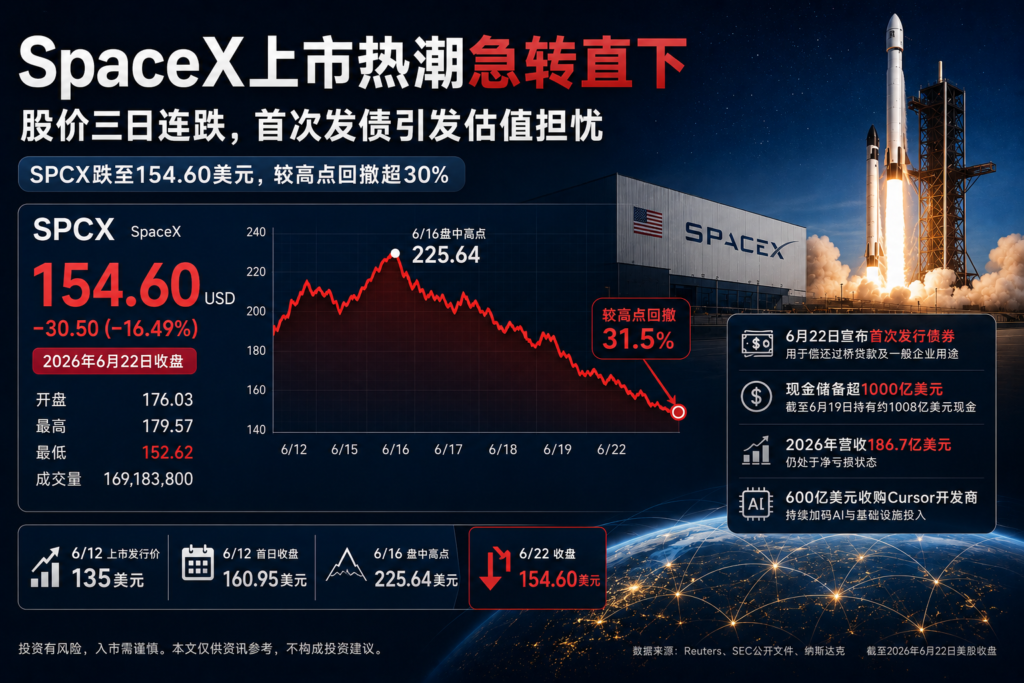
SpaceX completed its listing on 12 June at $135 per share and received $160.95 on the first day; the stock price subsequently rose to $225.64 on 16 June, following the opening of the option and the recovery of the bulk money.
On the basis of the latest closing price:
- About 31.5 per cent of the withdrawals above $225.64;
- The first day of the market, the closing price of US$ 160.95 has been broken;
- However, it is still about 14.5 per cent higher than the $135 IPO issuance price.
SpaceX was listed for a few trading days, and stock prices experienced a sharp increase to a large fall, reflecting a shift in the market from a “mask buy-out” to a reassessment of company valuations, losses, debt and long-term capital expenditure.
Information based on:
Reuters: after SpaceX came on the market, the boom in stock prices gradually cooled down.
Reuters: SpaceX options boosted the equity price to $225.04
I. Recent stock price performance of SpaceX
| Item | Data |
|---|---|
| Stock code | SPCX |
| 22 June 2026 closing price | 154.60 dollars |
| That day, it went up and down | Approximately – 16.5 per cent |
| The price at the day is open. | US$ 176.03 |
| The highest price at the moment. | 179.57 United States dollars |
| Minimum price for the day | $152,62. |
| It's a deal. | About 169 million shares. |
| IPO issuance price | $135. |
| The first day of the market. | US$ 160.95 |
| Top price on the market backboard | $225.64 |
| High point maximum retreat. | About 31.5 per cent |
| IPO distribution price increases. | About 14.5 per cent |
From the data, SpaceX did not break the IPO distribution price, but it basically threw up most of the increase.
This means that some of the investors that IPO pursued earlier were highly purchased, and that there had been a significant book loss.
ii. Why did SpaceX suddenly fall?
The fall in the current round was not caused by a single message, but by a combination of factors.
1. First bond issuance raises concerns about funding needs
SpaceX announced on 22 June that it would launch the first advanced unguaranteed bond issue in the company ' s history.
The company indicated that the collection of funds would be used to:
- (b) Repayment of bridge loans;
- (b) To cover the related costs;
- Support for general business purposes;
- Optimizing the maturity structure of debt.
SpaceX did not disclose in the bulletin the final size, interest rate and maturity of the bond.
While bond financing can avoid further stock creation and reduce direct dilution of existing shareholders, the market is more concerned with another issue:
Why does a firm that has just raised more than $85 billion through IPO and has more than $100 billion in cash on its books need to enter the bond market quickly?
Investors fear that this may mean that SpaceX will spend much more on artificial intelligence, Starship, satellite networks and data centres in the future than previously expected.
Official sources:
Form 8-K of the United States SEC: SpaceX first-time advanced unsecured bond
Reuters: SpaceX first entered the bond market and disclosed $10.8 billion in cash
2. Overvaluation after listing and withdrawal of profit-making funds
When SpaceX was released at $135, it was valued at approximately $1.77 trillion.
Stock prices rose by 19 per cent on the first day of the market and the company's market value exceeded $2.1 trillion.
Near the highest price, SpaceX was once close to $3 trillion, temporarily surpassing a number of large global technology enterprises.
However, SpaceX earned approximately $18.67 billion in operating income in 2025 and the company remains in a net deficit.
On the first day of the market, the market sales rate was about 112 times higher than most large technology companies.
The market is beginning to realize that:
- SpaceX has very strong growth expectations;
- However, their valuations have been pre-recorded for significant future successes;
- Starship and AI operations have not yet yielded stable profits;
- High-valued equities are more vulnerable to changes in interest rates and risk preferences.
It is no surprise that some investors have chosen to benefit from the early recovery of the mood when it cools.
Information based on:
Reuters: SpaceX's first-day market value exceeded $2 trillion.
3. AI operating capital expenditure questioned
SpaceX has gradually expanded from a traditional space and satellite communications company to a scientific and technological consortium with an artificial intelligence infrastructure deployed simultaneously.
The company is increasing its investments in the following areas:
- (a) The AI Computing Centre;
- High performance chips;
- Data centre infrastructure;
- The colossus computing platform;
- Enterprise artificial intelligence software;
- Orbital computing and communication networks.
While the rating agencies gave SpaceX investment-grade credit ratings, they also made it clear that the company ' s space and satellite communications operations were relatively robust, while AI operations faced:
- (b) High capital demand;
- (a) High competition in the market;
- Uncertainty about commercial returns;
- It is likely that profits will continue to be drawn down in the short term.
Thus, the current downturn reflects not only SpaceX ' s own problems, but also market concerns about the return on AI inputs across the entire United States technology industry.
Information based on:
Reuters: SpaceX obtains investment-grade credit ratings, and AI operations remain uncertain
Four hundred and sixty billion dollars to buy Cursor to further expand the AI bets.
SpaceX announced on 16 June that it had an acquisition agreement with the developer of the AI programming tool Cursor, Anyshere.
According to a paper submitted by SpaceX to the United States Securities and Exchange Commission, Cursor ' s implied equity valuation for this transaction is approximately:
$60 billion.
The trading plan, with SpaceX Class A ' s General Unit as the main counter-value, is expected to be completed in the third quarter of 2026, but regulatory approval and other conditions for delivery are still required.
This transaction shows SpaceX is fast entering the enterprise-level AI software market.
But it also raises new questions for shareholders:
- Whether Cursor is worth the $60 billion valuation;
- (b) Whether there is synergy with existing SpaceX operations following the acquisition;
- (b) Whether equity payments dilute existing shareholders;
- Whether SpaceX is simultaneously advancing too many high-cost projects.
The announcement of large AI acquisitions and bond financing just a few days after the completion of the IPO may have heightened the market ' s concern about the rapid pace of expansion.
Official sources:
United States SEC: SpaceX Acquisition of Form 8-K from Cursor Developer Anysphere
5. Relatively limited liquidity, which exacerbates stock price volatility
SpaceX IPO issues about 556 million shares, and despite the magnitude of the financing, the share of open circulation is still small relative to the company ' s total share.
The smaller disk means:
- Large purchase orders can easily push up stock prices;
- Large bills are also prone to rapid declines;
- Pumping behaviour of option traders may magnify volatility;
- The effect of the diaspora sentiment on short-term prices is clear.
After the opening of the 16 June deal on SpaceX stock options, more than half a million options contracts were concluded in the first hour alone, and the volume exceeded 1 million in the afternoon.
The options market helped to drive stock price increases at one point, but when the market reversed, hedge transactions could also magnify the decline.
iii. SpaceX has $10.8 billion in cash, and why is the market still worried?
According to company disclosures, as at 19 June 2026, SpaceX owned approximately:
$10.8 billion in cash and cash equivalents.
This is a huge cash reserve in globally listed enterprises.
As of the end of March 2026, the company’s cash and cash equivalents were about $15.9 billion. The rapid increase in cash was mainly due to its record IPO financing.
SpaceX in IPO:
- Basic distributions of about 556 million shares;
- (a) The issue price per share is US$ 135;
- (a) Basic financing of about $75 billion;
- (a) After the underwriter has exercised the right to oversale;
- Final financing increased to approximately $85.7 billion.
Even so, the market remains concerned because SpaceX simultaneously promotes a number of projects requiring huge capital:
- Starship research and development and testing;
- Starlink new generation satellite deployment;
- Rocket and satellite manufacturing plants;
- Extension of launch facilities;
- (a) The AI data centre;
- (b) High performance chip procurement;
- Cursor's acquisition;
- xAI-related business integration.
The high level of cash does not mean that the rate of cash consumption is low.
For investors, the more important issues are:
Can SpaceX generate sufficient stability of income and profits in the future for each dollar invested?
IV. Does the fall in the current round mean that SpaceX has failed to go public?
This is not yet the case.
Even though the stock price retreat exceeded 30 per cent, SpaceX ' s latest prices were still approximately 14.5 per cent higher than the $135 issue price.
From the perspective of IPO investors, corporate equity as a whole remains profitable.
In addition, SpaceX still has several important advantages:
1. Starlink has a real income base
Starlink has formed a global satellite Internet user and continued subscription revenue and is one of the most sophisticated commercial operations currently being conducted by SpaceX.
2. The commercial launch market leads
Falcon 9 has a clear size advantage in the global commercial space launch market and continues to carry out commercial, NASA and United States defence-related tasks.
3. Adequate cash reserves
$10.8 billion in cash could support SpaceX to advance large R & D and infrastructure projects over a longer period of time.
4. Obtaining investment-level credit ratings
Moody gave SpaceX Baa1 a rating, with BBB+ being given in good faith, and BBB being given a standard and with a steady outlook.
This means that the rating agencies consider SpaceX to have a strong debt solvency.
5. Mask still has control
Following the completion of the IPO, Mask still holds approximately 82 per cent of the voting power through a dual equity structure, facilitating the company ' s sustained implementation of its long-term strategy.
As a result, the current downward trend is more a result of post-market price discovery and valuation readjustments than of the sudden collapse of SpaceX ' s business model.
V. What are the concerns of multiple heads and empty heads?
Look at SpaceX's investors.
- Starlink could become a global communications infrastructure;
- Starship may significantly reduce the cost of space transportation;
- SpaceX has technical and scale advantages in the field of commercial launches;
- Government and military contracts provide stable revenue;
- AI and the satellite network could create new growth operations;
- SpaceX could be the next generation of global infrastructure enterprises.
According to investors who are cautious or blind
- Current valuations have over-reflected future growth;
- (b) The company has still not achieved stable net profits;
- Starship is heavily invested and has high technological risks;
- The expansion of AI requires constant burning of money.
- (b) The overprice of the $60 billion acquisition of Cursor;
- (b) The company is highly dependent on Mask individuals;
- Small rolls and options transactions can increase volatility;
- Debt financing will increase interest and repayment pressure.
The core difference between the two sides is not whether SpaceX has the leading technology, but rather:
Whether the future cash flows generated by these technologies and operations are sufficient to support the valuation of over trillions of dollars.
VI. What should be the next focus of SpaceX stock prices?
In short-term market performance, investors can focus on the following price areas.
$135: IPO issuance price
This is the cost of institutional and part-bundled subscriptions at SpaceX and is one of the most important psychological reference points at this time.
If the stock price falls by $135, which means that the IPO investors as a whole are in a state of loss, it may further discourage market sentiment.
Close to $150: open area on the market
SpaceX was launched on the first day of the market at approximately US$ 150.
The latest stock prices are close to the region, and it is a matter of concern whether the market can support them.
$160.95: Discount price on the first day of the market
The stock price has fallen to the first day of the market, indicating a loss for some of the investors bought on the first day.
US$ 185 to US$ 202: the pre-transaction intensive areas
This scope, which had been the main trading area in the second phase of the post-market period, could create a backlash in the future.
$225.64: High end of the market trail
New and significant benefits may be required to break that high point before valuation, profitability and capital expenditure concerns are significantly alleviated.
The above price is used only to describe open market trends and does not constitute a buy-in or sell-out proposal.
VII. Subsequent events that may affect the SPCX share price
1. Final bond issue terms
The market will focus on:
- Bond size;
- (a) The nominal interest rate;
- (a) The expiry date;
- (b) Investor subscription needs;
- Specific use of bond funds.
Some of these concerns may be mitigated if financing costs are low and institutional demand is strong; if interest rates are clearly high, they may indicate that bond markets consider corporate risk to be high.
2. Progress in Cursor acquisition
The acquisition of $60 billion with regulatory approval and the eventual distribution of SpaceX shares will influence shareholder dilution and AI strategic judgement.
3. Starship ' s next test flight
Starship is an important component of SpaceX ' s long-term valuation.
Can the next test flight improve:
- (b) booster recycling;
- Re-entry;
- Thermal protection systems;
- (b) Engine reliability;
- Orbital mission capabilities;
It may have a direct impact on market sentiment.
4. Starlink income and user growth
If Starlink continued to grow rapidly and improve profits, it would provide more stable fundamental support for SpaceX valuations.
First quarterly report of listed companies
The first official quarterly financial report after SpaceX is listed will be an important validation node.
Investors will focus on:
- (a) Business income;
- Starlink growth;
- Net profit or loss;
- Free cash flow;
- AI capital expenditure;
- Starship input;
- (c) The rate of cash consumption.
How should ordinary investors view fluctuations in the current round?
SpaceX is not a company that can easily be judged by traditional valuation methods.
It also has:
- (a) A mature rocket launch operation;
- Rapidly growing satellite communications operations;
- The Starship project, which is not yet fully mature;
- High-input AI operations;
- Super-high market valuation;
- (b) Smaller open circulation ratios;
- Very powerful Mask personal influence.
As a result, the SPCX may continue to experience significant increases or declines in the short term.
Investors need to distinguish between:
- Whether companies are leading in technology;
- Whether the company has long-term value;
- Does the current stock price reflect all optimistic expectations?
An excellent company does not mean that its shares have the same investment value at any price.
Concluding remarks
SpaceX stock prices fell by about 16.5 per cent on a single day, on 22 June, and were lower on the third consecutive trading day, with more than 30 per cent of the stock retreats being made at a higher point than after listing.
The main reasons behind the fall in the current round are:
- IPO is a profit return;
- Super-high valuation pressure;
- First bond financing;
- AI and Starship capital expenditure concerns;
- (a) The acquisition of Cursor by $60 billion;
- (b) Smaller liquidity and greater volatility in options transactions;
- The overall risk bias of the United States Science and Technology Unit has declined.
However, SpaceX still holds over $100 billion in cash and has fundamental face advantages such as Starlink, commercial launch, government contracts and investment-grade credit ratings.
The real re-evaluation of the market is not whether SpaceX can continue to develop, but rather:
After a mad rise in the early days of the market, investors should buy a future for SpaceX that has not yet been fully realized at what high prices.
Source and official link
1. SpaceX ' s most recent stock price and the retreat from the market
Reuters:SpaceX Shares Fall as Post-IPO Frenzy Loses Steam
SpaceX first-time debt and $10.8 billion in cash
Reuters:SpaceX Turns to Bond Market and Reports $100.8 Billion Cash
3. SpaceX Bond Issue Regulatory Document
US SEC: SpaceX Form 8-K-Senior Unsuccessed Notes
SpaceX is a record IPO.
Reuters:SpaceX Prices Record $75 Billion IPO at $135 a Share
5. First day of appearance of SpaceX
Reuters:SpaceX Surges Past $2 Trillion in Nasdaq Debut
6. SpaceX disk up to $225.64
Reuters:SpaceX Options Trading Fuels Post-IPO Surge
7. SpaceX investment-grade credit rating
Reuters:SpaceX Gets Investment-Grade Ratings with Stable Outlook
8. SpaceX acquisition of Anysphere, a Cursor developer
United States SEC: Acquisition of Anysphere Form 8-K
9. SpaceX investor relations and regulatory documents
SpaceX Investor Relations:SEC Filings
Disclaimer
This paper is based on open market developments, SpaceX regulatory documents and press reports and is used only for global financial information and corporate fundamentals analysis and does not constitute an investment proposal for any stocks, options, bonds or other securities.
The investor should judge independently on the basis of its own risk tolerance, and pay attention to high valuation, new stock trading, leverage, and options risk.