
The Japanese yen has been pushed to a historic juncture again.
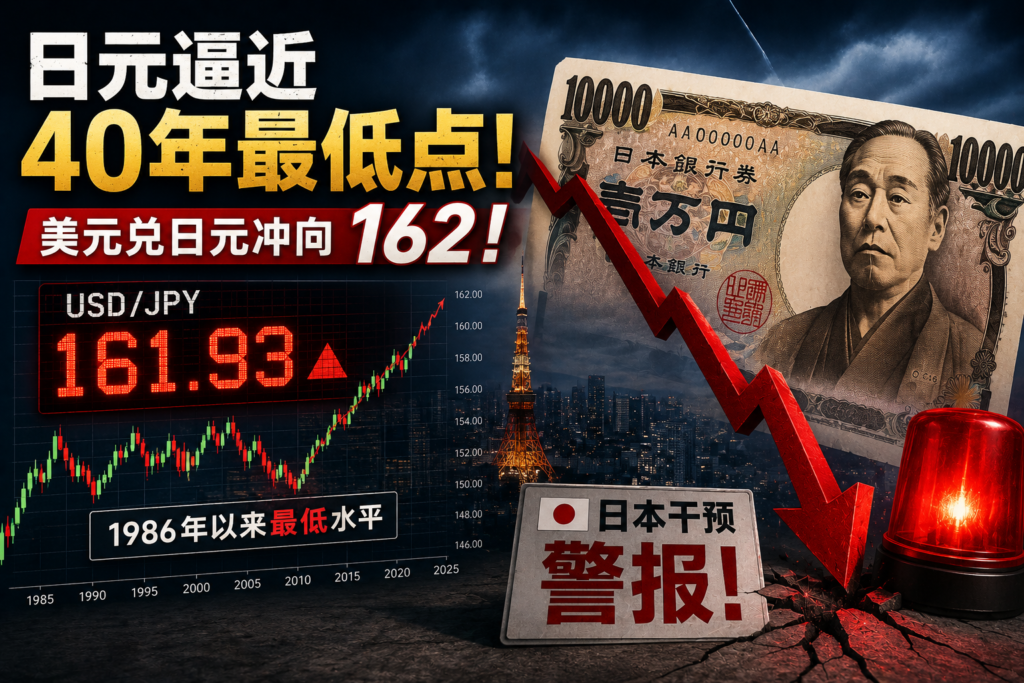
On 23 June 2026, the United States dollar was maintained above 161 yen, during which time it rose to:
US$ 1 to JPY 161.93.
This level is only 0.03 yen different from the 161.96 created in 2024.
If the United States dollar to the Japanese yen is officially exceeded by 161.96, the yen will fall to its lowest level since 1986, meaning that its exchange rate against the United States dollar is nearly 40 years weak.
The Japanese government had previously invested record money to intervene in the market, and the Japanese Central Bank had just increased interest rates, but the yen was still under pressure.
The market ' s most current concerns are:
Would the Japanese Government buy the Japanese yen again if the dollar to the Japanese yen were to be exceeded, or even coordinate its actions with the United States?
It needs to be noted that Japan has not yet been confirmed that it has initiated a new round of intervention, nor has the decision on joint intervention been published between the United States and Japan. But, as the yen approaches its historical lows, the foreign exchange market is on high alert.
Information based on:
1. What level of exchange has the Japanese yen fallen to?
As of 23 June, the core data for the latest Yen round are as follows:
| Item | Relevant data |
|---|---|
| The U.S. dollar is higher than the Japanese yen. | 161.93 |
| Lower in 2024. | 161.96 |
| Critical psychological barriers | 162.00 |
| Over the post-161.96 level. | Weakest since 1986 |
| Central Bank of Japan policy rate | About 1.0 per cent |
| Federal Reserve policy interest rate | 3.50%—3.75% |
| US-Japan policy spread | About 2.50-2.75 percentage points |
| Amount of recent Japanese intervention | About 1,173.49 trillion yen. |
The Japanese yen has now largely rebuffed the appreciation brought about by previous government interventions.
In late April and early May, the Government of Japan sold the United States dollar on a large scale after the Japanese yen fell by 160, bought it, and at one point pushed the yen back sharply.
However, as the market reset the Fed’s interest rate, and the interest rate of the United States dollar continued to be higher than the Japanese rate, the yen fell back into the pre-intervention region.
ii. Why is the yen still falling after the Japanese Central Bank (JCB) hike?
The Bank of Japan has raised short-term policy interest rates to:
1.0%。
This was an important step in the normalization of Japan ' s ultra-lax monetary policy over the years and at relatively high policy interest rates over the decades.
At the same time, the Bank of Japan stated that if the economic, price and financial environment continued to evolve as expected, policy interest rates would continue to be raised and monetary easing gradually reduced.
However, the yen did not continue to appreciate as a result, mainly because of:
1. Interest rates in the United States remain significantly higher than in Japan
The Federal Reserve currently maintains the Federal Fund interest rate target zone at:
3.50%—3.75%。
Even if Japan's interest rate rose to 1.0 per cent, the United States policy rate was about 2.5 to 2.75 percentage points higher.
Investors hold United States dollar assets and are generally able to earn higher interest earnings than Japanese yen assets.
Official sources:
Central Bank of Japan: currency market operations adjustment in June 2026
Federal Reserve: June 2026 FOMC Monetary Policy Statement
2. Market re-instatement of the Fed interest rate
The United States economy continues to perform resiliently, and inflation continues to be higher than the Federal Reserve target of 2 per cent.
As at 23 June, Federal Fund futures reflected the market's expectation that the Fed would increase interest rates by about 75 per cent by September.
Maintaining high rates of return on the United States Treasury debt has also increased the attractiveness of United States dollar assets to global finance.
3. Japan ' s real interest rate remains low
Even if nominal interest rates rise to 1.0 per cent, Japan ' s real interest rates may still be in a negative region, taking into account inflation and price expectations in Japan.
This means that the financial environment in Japan remains generally relaxed and is not sufficient to reverse the long-term Japanese yen financing and dollar investment needs altogether.
III. What's a Japanese yen arbitrage?
Long-term interest rates in the yen are low and are often used as a currency for financing by global institutions and investors.
Common operations are:
- (b) Borrowing Japanese yen at lower interest rates;
- (a) Converting the Japanese yen into United States dollars;
- Purchase of higher-yielding United States bonds or dollar assets;
- (b) Obtaining a difference in interest between the two countries;
- If the yen continues to depreciate, it may also receive a significant exchange gain.
Such transactions are commonly referred to as:
Yen Carry Trade, Yen arbitrage.
As long as the interest rate in the United States is significantly higher than in Japan and the market does not believe that Japan will suddenly increase its interest rate significantly, borrowing in Japanese yen to purchase United States dollar assets will remain attractive.
The arbitrage deal will be sustainable:
- Selling Japanese yen;
- Purchase of United States dollars;
- (b) Raise the United States dollar to the Japanese yen;
- The Japanese yen is devalued.
While the Japanese Government’s intervention could hit speculative funds in the short term, it would be difficult to change the basic trend of interest rate differentials in the long term, when the market was heavily charged in the same direction.
4. How much has Japan spent on intervention in the Japanese yen?
According to data published by the Ministry of Finance of Japan, between 28 April and 27 May 2026, the Government of Japan implemented:
Foreign exchange intervention of 11.7349 trillion yen.
The $72 billion to $74 billion contractually contracted is one of the largest single-round exchange-rate interventions in Japan ' s history.
Official sources:
Ministry of Finance of Japan: Foreign exchange intervention data, 28 April-27 May 2026
Japanese yen buy-in interventions are usually:
- The Ministry of Finance of Japan made an intervention decision;
- The Bank of Japan carries out transactions on behalf of the Ministry of Finance;
- Selling the United States dollar in the foreign exchange market;
- (a) Buying Japanese yen from the funds received;
- The exchange rate rebounded by increasing the demand for yen.
The previous intervention, which had led to a marked appreciation of the yen, returned to the vicinity of 161 as the United States-Japan spread and the demand for the dollar returned to dominate.
This indicates that:
Interventions can change short-term prices and the pace of transactions, but the long-term effects are usually limited if the fundamentals remain unchanged.
V. Why is Japan so worried about the Japanese yen’s devaluation?
A moderate yen depreciation could increase the price competitiveness of Japan ' s exports and increase the amount converted from overseas earnings to the amount after the yen.
However, when the yen depreciates too rapidly, there will also be a clear negative impact.
Increased cost of energy imports
Japan is highly dependent on imported crude oil, natural gas and other energy sources.
When the yen depreciates, even if international oil prices remain constant, Japanese enterprises and consumers will need to purchase the same amount of energy with more yen.
2. Rising prices of food and raw materials
Prices of imported food, chemical raw materials, metals, spare parts and consumer goods are affected by exchange rates.
Weak yen increases business costs and may eventually be passed on to consumers through price increases.
3. Declining real purchasing power of the population
If wages rise at a rate that does not keep pace with higher import prices, the real income and consumer capacity of Japanese households will be squeezed.
Increased pressure on SMEs
While large exporting enterprises usually benefit from weak yen, SMEs that rely on imported raw materials and are unable to quickly increase their sales prices may face greater operating pressures.
5. Further rise in inflation risk
The Central Bank of Japan has warned that higher crude oil prices and exchange rate fluctuations could lead to faster transfer of costs to consumer prices, bringing inflation above the target of 2 per cent.
VI. Whether the yen depreciation is good for Japanese firms or not?
The impact is not exactly the same.
Sectors of potential benefit
- Automobile exports;
- Mechanical equipment;
- Electronic products;
- Enterprises with a high proportion of overseas operations;
- Tourism and hotels;
- (c) Detail and duty-free retailing.
When an enterprise earns income abroad in United States dollars or other foreign currency, it may increase income and profits in the financial statements when converted into yen.
The industries that may be under pressure.
- (a) Airlines;
- Energy enterprises;
- Food processing;
- Import and retail trade;
- Manufacturing relying on raw materials from abroad;
- Enterprises that are highly dependent on imported equipment.
Weak yen is not absolutely good for the Japanese stock market.
Exporters may be supported if the yen is only mildly depreciated; but if the exchange rate is out of control, leading to inflation, rising interest rates and falling consumption, the overall market may also be under pressure.
7. What is the impact of the depreciation of the yen on ordinary people?
To Japanese residents.
Depreciation of the yen means:
- Higher costs of overseas travel;
- Increase in the cost of study abroad;
- (a) Increased prices of imported goods;
- Energy and food price containment;
- The value of overseas assets rose in Japanese yen.
For overseas tourists to Japan.
If tourists hold the United States dollar, the renminbi or other relatively strong currencies, the depreciation of the yen usually means:
- Hotel prices are relatively low;
- Lower purchase costs;
- (b) Food and transport are cheaper;
- Japan ' s tourist attraction has increased.
For Japanese students and overseas workers
The purchasing power of foreign exchange to the Japanese yen from the sea may increase, but the cost of paying school fees, rents or maintenance outside Japan will increase significantly.
VIII. Why is 162 considered an important point by the market?
162 is not an intervention line in itself officially published by the Government of Japan.
The Government of Japan does not usually announce in advance intervention at a fixed price, as this would allow speculators to set up ahead.
However, the market is concerned with 162, mainly because:
- 161.96 is a significant low, which was created in 2024;
- The breakthrough will be followed by a minimum of 40 years;
- Integer levels have greater psychological significance;
- The rate of depreciation of the yen could be further accelerated;
- The political and inflationary pressures of the Japanese Government will rise markedly.
Markets are truly looking at not only prices, but also at:
- (b) The rate of single-day movements of exchange rates;
- Whether there is unilateral speculation;
- (a) Whether the transaction is irregular;
- Whether the yen has quickly broken through several gates in a short time.
Japanese officials usually place more emphasis on “excessive and disorderly fluctuations” than on specific exchange rate levels.
IX. Will Japan intervene again?
The possibility of Japan re-emerging is on the rise, but the timing is difficult to predict.
The factors that support re-intervention include:
- (a) The yen is close to 40 years ' minimum;
- The effects of recent interventions have largely disappeared;
- (a) The speculative increase in the yen;
- (b) The continuing rise in energy and import costs;
- The rapid depreciation of the yen has increased political pressure.
But the Japanese Government also needs to consider:
- Whether unilateral intervention can produce sustained results;
- The US-Japan policy spread has not disappeared;
- Excessive and frequent interventions could deplete foreign exchange reserves;
- Whether the United States supports its reasons for intervention;
- Whether the market sees intervention as a new and empty opportunity.
The Japanese Minister of Finance, Kiyoyama, recently held an online meeting with United States Treasury Minister Scott Besent to discuss the financial markets and the volatility of the yen.
To date, however, no joint intervention plan has been announced by the parties.
Information based on:
Reuters: Japanese foreign exchange communication keeps the market on alert.
X. What is the difference between Japan ' s individual intervention and the United States-Japan joint intervention?
Japan ' s individual intervention
By decision of the Ministry of Finance of Japan, it is implemented mainly through the sale of United States dollars and the purchase of yen.
The advantages are:
- (b) Be able to move quickly;
- It is not necessary to wait for the formal participation of other countries;
- Market volatility can be increased in a short time.
Limitations are:
- (a) Limited size of funds relative to the global foreign exchange market;
- It is difficult to counteract interest rate trends in the long term;
- The market may redo empty yen after intervention.
United States-Japan coordination or joint intervention
Possible include:
- The U.S. has publicly supported Japan ' s initiative;
- (a) The coordination of the two Governments;
- The United States Treasury or the Federal Reserve in New York are involved in the transaction;
- The major economies jointly send out policy signals.
Joint operations usually have greater psychological deterrents, but the threshold is also higher.
The United States is generally more likely to support direct action only if exchange rate fluctuations have a clear impact on global financial stability or are perceived to be irregular transactions.
Can the interest rate increase really save the yen?
In theory, the continued interest rate hike by the JCB could reduce the US-Japan spread, thereby reducing the attractiveness of borrowing Japanese yen and purchasing dollar assets.
But the increase also has side effects:
- (b) The increase in the cost of interest on the Japanese Government ' s debt;
- Increased cost of mortgages and business finance;
- Economic growth could slow down;
- Increased pressure on SMEs to service their debt;
- The country ' s debt market has become more volatile.
Thus, the Central Bank of Japan cannot quickly and significantly increase interest rates for exchange rates alone.
Its policies also need to take into account:
- Inflation;
- Wages;
- Consumption;
- Employment;
- Economic growth;
- The financial system is stable.
The Central Bank of Japan has indicated that it will continue to raise interest rates, but will judge the exact rate according to economic, price and financial conditions.
12. What are the three possible trends in the future of the yen?
Scenario 1: Japan ' s immediate intervention
If the United States dollar to the Japanese yen breaks through 162 quickly and continues to move to 163 or higher positions, Japan may suddenly sell the United States dollar and buy the yen.
The Japanese yen may rebound quickly in the short term, but the market may retest its heights later if the interest rate in the United States is expected to remain unchanged.
Scenario 2: Japan continues to give verbal warning
If the exchange rate fluctuates slowly, the Government of Japan may continue to release the warning, but will not actually enter the market.
In such cases, the market may repeatedly test the vicinity of 162 while maintaining vigilance over sudden intervention.
Scenario three: the Federal Reserve's interest rate hike is expected to continue to increase.
If inflation and economic data in the United States are strong and the market is further at a premium, the dollar against the yen may continue to rise.
Even with Japanese intervention, interest rate differentials may make the yen rebound unsustainable.
What risks do foreign exchange investors need to focus on?
The current risk of transactions between the United States dollar and the Japanese yen has increased significantly.
Risk of sudden intervention
The Japanese intervention usually does not take place with formal notice, and the United States dollar to the Japanese yen may fall a few yen quickly in a few minutes.
Leverage risk
Foreign exchange transactions are often leveraged, and small price fluctuations can also result in significant losses.
Night jump risk
Government news, central bank policy and geopolitical events may lead markets to jump short when liquidity is insufficient.
Risk recovery
As exchange rates are near historical highs, continuing to raise the dollar may yield gains, but it is also vulnerable to rapid reversals triggered by interventions.
Two-way policy risk
Japan may intervene or increase interest rates, or the United States may adjust interest rates, and policy changes on either side could lead to a reversal of the exchange rate.
XIV. What information should be followed up?
The market needs to focus next on:
- Whether the United States dollar to the Japanese yen has exceeded 161.96;
- (b) The sustainability of the 162nd pass;
- (a) The position of the Ministry of Finance and Cabinet officials in Japan;
- The Japanese Central Bank followed up on the pace of the hike;
- Data on foreign exchange interventions in the Ministry of Finance of Japan;
- United States inflation and employment data;
- The Fed ' s probability of raising interest rates;
- (a) The United States biennial sovereign debt return;
- International crude oil prices;
- Whether or not United States and Japan announce further coordinated action.
The Ministry of Finance of Japan expects to publish summary data for the next phase of foreign exchange interventions on 30 June, by which the market will judge whether unrecognized government transactions are forthcoming.
Concluding remarks
The yen is approaching its weakest level in nearly 40 years.
The United States dollar rose to 161.93 yen at one time, just one step from the 2024 low point of 161.96.
Even though the Bank of Japan raised the policy interest rate to 1.0%, and the Japanese government had previously invested about 11.7 trillion yen in intervention in the market, there was still a clear spread between the United States and Japan, and the Japanese yen arbitrage had not really disappeared.
The Japanese Government may intervene again, but the ability to reverse the long-term trend will depend on:
- The Federal Reserve interest rate policy;
- The rate of interest hike by the Central Bank of Japan;
- International energy prices;
- Market speculation;
- Level of United States-Japan policy coordination.
For the market, 162 is not only a number of exchange rates, but also a new test of the policy credibility and intervention capacity of the Government of Japan.
Source and official link
1. Yen is approaching its lowest point of 40 years
Reuters:Dollar Firms as Yen Nears a 40-Year Low
2. Japan ' s recent exchange rate intervention and government stance
Reuters:Japan’s FX Messaging Keeps Markets on Intervention Watch
3. Amount of Japanese foreign exchange intervention
Ministry of Finance of Japan: Foreign exchange intervention data, 28 April-27 May 2026
4. Recent interest rate decision of the Central Bank of Japan
Central Bank of Japan: currency market operations adjustment in June 2026
5. Federal Reserve ' s latest policy interest rate decision
Federal Reserve: June 2026 FOMC Statement
6. Foreign exchange intervention data from the Ministry of Finance of Japan
Disclaimer
This paper is organized on the basis of open market data, the Ministry of Finance of Japan, the Central Bank of Japan, the Federal Reserve and press reports and is used only for global financial information and foreign exchange market analysis and does not constitute any foreign exchange, securities or derivative investment proposal.
There is a high risk of volatility and leverage in the foreign exchange market, and the Japanese government may intervene without prior notice.