
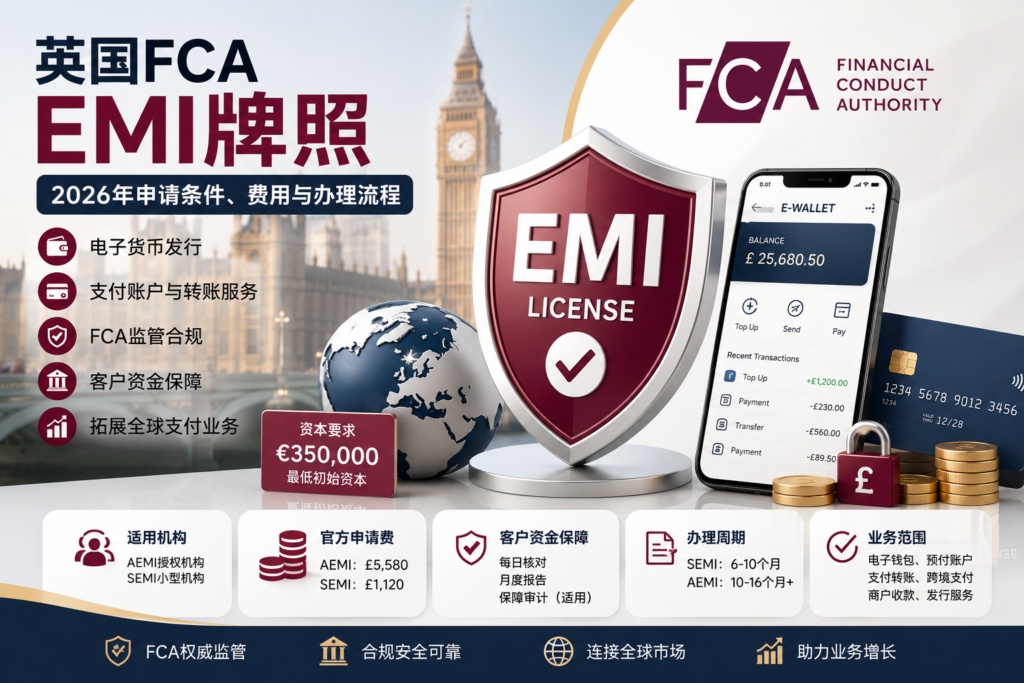
For enterprises planning to conduct electronic wallets, prepaid accounts, electronic money issuances, payment accounts, money transfers or related financial technology operations in the UK, the delegation of authority from the British FCA Electronic Money Agency is one of the important regulatory pathways.
The full name of the EMI is:
Electronic Money Institution
The UK market is divided into two main electronic money institutions:
- Authorised Electronic Money Institution,AEMI
- Small Electronic Money Institution,SEMI
It is commonly referred to in the market as a “British EMI licence”, but the size of the business, the terms of application, the capital requirements and the scope of application are not the same.
Before applying, enterprises need to make clear that:
- Whether electronic money is actually issued;
- Whether the client is able to store the value of the funds in the account;
- Whether the balance of the reserve value can be paid to third parties;
- Whether payment accounts or transfer services are provided;
- (b) Whether the customer is mainly located in the United Kingdom or elsewhere;
- (a) The expected size of the client ' s funds;
- Whether it is necessary to provide services to retail customers;
- (b) The availability of British local management and operational capacity;
- Is it possible to establish a system of customer financial security?
The FCA reviews business models, management teams, capital strength, customer financial security, anti-money laundering regimes, technology systems, and practical operating arrangements in the UK.
An EMI application from England is being evaluated?
COVIS can assist in the preliminary determination of whether it is suitable to apply for AEMI or SEMI by submitting business model, expected client funding scale, target market and existing team information.
I. What is the UK FA EMI?
EMI is an electronic money agency that is regulated by the British Financial Conduct Regulatory Authority (FCA) under the Electronic Money Regulations 2011.
Electronic currency usually means:
- (b) The monetary value stored electronically;
- (b) The enterprise issues the funds upon receipt;
- Claims on behalf of the issuer vis-à-vis customers;
- A third party other than the issuer may accept it as a form of payment.
Common business scenarios include:
- Electronic wallets;
- (a) Advance accounts;
- Balance of payment cards;
- (a) Commercial payment accounts;
- Cross-border payment accounts;
- (a) Mobile payment applications;
- Reserve value products that can be used for third-party consumption or transfer.
Where the customer simply pays the enterprise for a commodity or service, it does not normally represent a certain amount of electronic money issued by the enterprise.
The key to determining whether an enterprise requires an EMI mandate is:
- (a) Whether the client ' s funds are received;
- Whether the electronic reserve value is issued on the basis of the fund;
- Whether the customer can use the reserve value to pay third parties;
- Whether the value constitutes a claim against the issuer;
- Whether there are applicable legal exclusions or immunities.
Official sources:
English Electronic Money Studies 2011
FCA:Payment Services Regulations and Electronic Money Regulations
II. What is the difference between AEMI and SEMI in England?
The U.K. EMI is divided into AEMI and SEMI.
AEMI: Authorized EMI
AEMI is suitable for enterprises planning to undertake larger e-money and payment operations.
The main features include:
- The need for formal authorization from the FCA;
- The minimum initial capital is Euro350,000;
- No ceiling for the average outstanding electronic currency size of 5 million euros for SEMI;
- More extensive electronic currency and payment services can be requested;
- There is a need for a complete system of governance, control and client funding;
- Continued capital and reporting requirements are higher.
SEMI: Small e-money agency
SEMI is a registered route and suitable for smaller businesses.
Under the terms published by the FCA, SEMI is normally required to:
- The average outstanding electronic currency does not exceed Euro5 million;
- Where payment services are provided that are not related to electronic currency issuance, the monthly average amount of the transaction is usually not more than Euro3 million;
- No account information service AIS;
- (b) Not provide a payment initiation service;
- (b) The absence of convictions for financial offences by managers;
- It is consistent with small institutional size limits.
Core differences
| Comparative items | AEMI | SEMI |
|---|---|---|
| Form of regulation | FCA's official authorization | Registration of small FCA institutions |
| Initial capital | Minimum Euro350,000 | Based on the scale of operations |
| Size of operations | Fits to larger operations | 5 million euros, etc. |
| Scope of payment services | Relatively wider | Operating restrictions in place |
| AIS/PIS | Qualified to apply | Not available |
| Governance requirements | More complete. | Relative simplification but still required compliance |
| Financial security of clients | Forced request | E-money still needs to be secured |
| Fit for business | Grown-up payment and financial technology enterprises | Small-scale or initial projects |
Official sources:
FCA:Electronic money institution applicants
III. What can be done by the UK EMI?
The scope of the specific business depends on the authorization or registration of the FCA obtained by the enterprise.
AEMI may involve:
- Issuance of electronic currency;
- Electronic wallets;
- (a) the balance of the advance payment;
- (a) Payment accounts;
- Payment and collection services;
- (a) Transfer of funds;
- Remittances;
- Business settlement;
- Services related to payment cards;
- Direct debit;
- Credit transfers;
- Payment of initiating services;
- Account information services;
- Payment services related to electronic currency issuance.
Enterprises may also provide partial payment services through agents or cooperating agencies, but agents are required to register and EMI has supervisory responsibility.
It needs to be noted that obtaining an EMI authorization does not mean that an enterprise can automatically:
- Receiving bank deposits;
- Providing savings accounts;
- (b) Unrestricted loans;
- Operating portfolio investment services;
- Providing fund management;
- Provision of foreign exchange brokering transactions;
- (a) underwriting securities;
- (a) Free operation in all EU countries;
- Automatically acquire direct membership in the bank liquidation system.
When enterprises involve both digital assets, securities, credit or foreign exchange transactions, other regulatory requirements need to be assessed.
IV. Is the UK EMI a bank licence?
Nope.
EMI is the regulator of electronic money and payment services and is not a bank and cannot promote customer electronic money balances as bank deposits.
The main differences between EMI and banks include:
| Comparative items | EMI | Bank |
|---|---|---|
| Main operations | Electronic currency and payment services | Deposits, loans and consolidated banking |
| Regulatory bodies | It's mostly FCA-controlled. | FCA and PRA jointly regulate |
| Nature of client funds | Electronic currency and disbursement funds | Bank deposits |
| Means of financial protection | Safeguarding client funding | It usually involves deposit guarantee systems. |
| Whether or not deposits can be absorbed | You can't take deposits as a bank. | Yeah. |
| Capital requirements | AEMI minimum 350,000 euros. | It's usually pretty much higher. |
EMI shall secure the funds received by the relevant client through the segregation of the client ' s funds or other means of authorization.
The distinction between a customer’s financial security is not equal to bank deposit insurance.
V. Which enterprises are eligible to apply for the UK EMI?
Electronic wallet platform
Clients can charge, keep and use the balance for transfers, payments or consumption.
2. Cross-border payment enterprises
Provision of services to individuals or enterprises for payment, collection and transfer of funds between different regions.
3. Financial Science and Technology Account Platform
Clients are provided with payment accounts, virtual accounts, payment tools or account balance management functions.
4. Prepaid and payment card items
Issue or manage prepaid, virtual or payment card products related to electronic currency balances.
5. Commercial payment and settlement platforms
Collections, balance management, vendor payments and settlement services are provided to commercial households.
6. B2B payment agencies
Provides bulk payments, international settlements, employee cost management or supply chain payment services to business clients.
7. Embedded financial platform
The payment account, wallet or electronic money function is embedded in an electrician, software, platform or other business scene.
VI. Which enterprises do not necessarily need EMI?
The following items may not be suitable for direct application of EMI:
- Only payment software is provided, and no client funds are contacted;
- Provide technical interfaces only;
- (a) Only the sale of the goods or services of the enterprise;
- Storage values can only be used in very limited commodities or businesses;
- Only account information queries are provided;
- (b) Only the payment initiation service;
- Only one-time payments to commercial agents are made;
- (b) Not issue electronic currency acceptable to third parties;
- Business is more in line with Payment Integration than EMI.
Some enterprises may be better suited to:
- Authorised Payment Institution;
- Small Payment Institution;
- Registered Account Information Service Provider;
- EMI or PI agents;
- Technical service providers subject to regulatory authority.
Before a decision is made to apply for EMI, the classification of operational controls should be completed and the wrong type of permit should be avoided.
How much is it going to cost for the UK FCA EMI in the year 2026?
In the United Kingdom, there is no uniform commercial service price applicable to all enterprises.
The actual costs depend primarily on:
- Application for AEMI or SEMI;
- Business model;
- (a) The range of paid services;
- Whether retail customers are involved;
- (a) The expected size of the client ' s funds;
- Target client countries;
- Whether there are British companies;
- Directors and management team configuration;
- Whether there are compliance officers and MLROs;
- Whether a technology platform exists;
- Whether there is a customer funds guarantee banking programme;
- Whether to use agents or outsourced services;
- Completeness of existing application documents.
COVIS integrated project reference budget
| Type of project | Integrated reference budget |
|---|---|
| Registered at the Small Electronic Money Institution of SEMI, United Kingdom | USD 60,000-100,000 |
| Standard AEMI authorization request for England | USD 180,000-280,000 |
| Cross-border, multi-product or complex AEMI projects | USD 280 000-450,000 |
| Complete project with technology, compliance and operational landing | More than $350,000-600,000 |
The above reference budget for business services, which is a complete project, is not an official application fee under the FCA and does not include Euro350,000 in regulatory capital.
The integrated projects may include:
- EMI applicability assessment;
- AEMI versus SEMI path;
- British company and equity architecture planning;
- Business model and fund flow combing;
- Management team information preparation;
- Programme of Operations;
- Business plans;
– Three-year financial projections; - Capital calculations;
- (a) The client funds security programme;
- AML and the financial criminal system;
- Governance and risk management systems;
- Information security and business continuity documents;
- (a) Withdrawal and liquidation plans;
- FCA Contact requests for assistance;
- Assistance in response to regulatory issues.
If the applicant already has a British company, a mature payment team, a complete technical system and partial compliance documentation, the actual service option may be lower than the public budget.
Access to EMI cost assessment, United Kingdom
The submission of business models, the expected size of client funds, team configurations and available material could further assess the appropriate application path and actual budget.
VIII. What is the official application fee for the FCA?
Based on the cost criteria applied by the FCA from April 2026:
- Small EMI belongs to Category 3;
- Authorised EMI belongs to Category 5.
The current counterpart costs are:
| Type of application | FCA cost category | Official application fee 2026 |
|---|---|---|
| SEMI Registration | Category 3 | GBP 1,120 |
| AEMI authorized | Category 5 | GBP 5,580 |
FCA application fee is not refundable.
Even if the enterprise withdraws its application or the application is not approved, the application fee paid will not normally be refunded.
FCA official application fees do not include:
- British company registration;
- Regulating capital;
- Professional consultancy services;
- Wages for compliance personnel;
- Office space;
- Technical systems;
- Legal documents;
- Audit;
- (b) Client funds security accounts;
- Bank and payment network access;
- Annual regulatory costs.
Official sources:
FCA:Authorisation and registration application fees
How much regulatory capital does AEMI need?
The application for AEMI in England requires at least:
Initial capital of Euro350,000.
The capital is not a fee paid to the FCA, nor is it a deposit charged by the service provider.
It is the regulatory capital of the applicant ' s own business that needs to be held on a continuous basis and from which to prove its origin.
AEMI also needs to meet its own financial requirements on a continuous basis when it is granted.
- Initial capital requirement of Euro350,000;
- Amount calculated on the basis of Method D.
Method D is usually calculated at 2 per cent of the average outstanding electronic currency.
If an enterprise provides payment services that are not related to electronic money issuance at the same time, it may also need to calculate separately the continuing capital requirements of the related payment services.
Regulatory capital should:
- (a) Existence;
- (a) Legal origin;
- (a) Be available to the applicant enterprise;
- (a) Not belonging to the client ' s funds;
- Not from unverifiable temporary borrowing;
- Compliance with regulatory requirements during applications and ongoing operations.
Official sources:
English Electronic Money Studies 2011
FCA:Payment Services and Electronic Money – Our Approach
How much capital does the UK SEMI need?
The capital requirements of SEMI relate to the average amount of electronic money outstanding.
According to the FCA regulatory note:
- When the average outstanding electronic currency is less than Euro500,000, there is usually no fixed initial capital requirement;
- When Euro500,000 is reached or exceeded, the capital requirement is usually at least 2 per cent of the average outstanding electronic currency.
However, even without a fixed minimum capital, enterprises still need to prove that:
- (a) Have sufficient operating funds;
- Be able to support anticipated operations;
- Be able to meet technical and human costs;
- (b) The ability to implement risk management on a continuous basis;
- Insufficient funding will not harm clients.
The size of SEMI operations also needs to remain below the corresponding threshold.
XI. What are the conditions to be met in applying for the UK AEMI?
1. A viable business model
Enterprises need to make clear that:
- What electronic currency is issued;
- Why does the customer use the product;
- How the customer can fill the value;
- How funds are channelled;
- How the balance was used;
- How clients transfer or pay;
- How the customer redeems the electronic currency;
- How companies generate revenues;
- Whether to use card organizations, banks or other paying partners.
Business plans need to be more than industry-specific, and need to be consistent with technology systems, contracts, financial flows and financial projections.
2. Appropriate British operating arrangements
The FCA needs to be able to effectively supervise the applicant enterprise.
The enterprise should certify that at least some of its electronic currency and payment services will be operated in the United Kingdom and that it has British operating and management arrangements that match the scale of its operations.
The mere use of a virtual address, the absence of a management team or all important decisions are taken outside the country, which may make applications more difficult.
3. Experienced management teams
Directors and personnel responsible for electronic money and payment services need:
- Good reputation;
- (a) Have the appropriate knowledge;
- Have relevant experience;
- (b) Sufficient time for the performance of their functions;
- Understanding British regulatory obligations.
Common core positions include:
- Directors;
- Chief Executive Officer;
- (b) The compliance officer;
- MLRO;
- Risk managers;
- (b) Financial Officer;
- (b) The head of technical and information security;
- Operator.
4. Qualified shareholders and controlling persons
Persons or companies that hold, directly or indirectly, 10 per cent or more of capital or voting rights, or are capable of exerting a significant influence on the enterprise, usually belong to the holders of Qualifying Holding.
The FCA will assess:
- (b) Shareholders ' status;
- Source of funds;
- Financial capacity;
- (b) Regulatory records;
- Business reputation;
- (b) Proceedings and criminal records;
- Control relationships with enterprises.
5. Complete governance and internal controls
Enterprises need to have:
- Clear organizational structure;
- Division of responsibilities;
- Decision-making processes;
- Risk management;
- Financial controls;
- Internal audit or independent review;
- Outsourcing management;
- (a) Incident reports;
- Board supervision;
- Compliance monitoring plan.
6. Financial security of clients
An enterprise needs to prove that the customer funds received can be sequestered from the company ' s own funds or protected by means of insurance or guarantees in accordance with the regulations.
7. Anti-money-laundering and financial crime control
Businesses need to establish business risk-compatible:
- (a) Customer identification;
- Client risk rating;
- Screening of sanctions lists;
- Screening of politically exposed persons;
- (b) Control of transactions;
- Suspicious activity reports;
- High-risk country management;
- (b) Anti-fraud controls;
- (b) Staff training;
- Independent review.
XII. New requirements for customer funding security in 2026
As of 7 May 2026, the U.K. EMI has applied the new CFT rules.
The requirements focus on:
- (a) Separation of client funds from the enterprise ' s own funds;
- At least daily internal and external fund reconciliations;
- (b) More rigorous due diligence of client funding cooperation agencies;
- Create and continuously update the Resolutory Pack;
- (a) Submit client financial security reports to the FCA on a monthly basis;
- (b) Accept annual assurance audits of qualified auditors, where applicable;
- Client funds can be identified and returned more quickly in the event of insolvency.
At the application stage, an enterprise needs to prepare its client fund security programme in accordance with current standards.
It should not simply be written “to search for a bank after future approval”, but should indicate, to the extent possible:
- (b) The type of bank or institution that is planned to be used;
- How the financial accounts are named;
- How to distinguish between client and corporate funds;
- How to conduct daily reconciliations;
- (a) How to deal with shortfalls where they occur;
- Who is responsible for oversight;
- How the audit record is developed;
- How to return the funds in case of failure of the enterprise.
Official sources:
FCA:Safeguarding requirements for payment and e-money institutions
FCA:Changes to the safeguarding regime for payments and e-money firms
XIII. What materials are required to prepare an EMI application for the UK?
Corporate and equity information
- Certificate of registration of British companies;
- (a) The charter of the company;
- (b) Shareholders ' lists;
- Roster of directors;
- Information on the ultimate beneficial owner;
- Group structure;
- Associated company information;
- (a) Shareholders ' sources of funding;
- Registered address and main office address.
Management team information
- Biographical information;
- Passport and address certificate;
- Education and professional qualifications;
- Experience in payment or electronic currency;
- Compliance and anti-money-laundering experience;
- Previous supervisory positions;
- (b) Proceedings and disciplinary proceedings;
- (b) A statement of time input;
- Job description.
Operational request information
- Programme of Operations;
- Business plans;
- Business processes;
- Client type;
- Target markets;
- Product description;
- Fees patterns;
- Three-year financial projections;
- Pressure testing;
- Capital calculations;
- (a) Market extension programmes;
- (a) A client flow chart;
- Note by the cooperating agency.
Compliance and risk documentation
- AML and the financial criminal system;
- (b) Customer identification procedures;
- Sanctions screening system;
- Fraud risk management;
- (a) The client ' s financial security policy;
- Risk management framework;
- Compliance control plans;
- (b) Complaints-handling procedures;
- Conflict of interest policy;
- Outsourcing management system;
- Agent management system;
- (a) Incident reporting process;
- Record-keeping policy.
Technical and safety information
- Technical architecture;
- Data flow maps;
- Access control;
- Information security policy;
- (b) Cybersecurity risk assessment;
- (b) Management of sensitive payment data;
- Business continuity plan;
- Disaster recovery plan;
- Reports of major security incidents;
- Information on third-party technical service providers;
- Infiltration testing and systematic monitoring programmes.
Exit and Clearing Materials
- Wind-down Plan;
- (a) Business closure;
- Client notification mechanisms;
- (b) The process of returning the client ' s funds;
- (a) Exiting costing;
- Key personnel arrangements;
- Data and record-keeping;
- (c) Termination of the arrangement by the cooperating agency.
XIV. ENGLAND FCA EMI COMPLETE PROFESSIONAL
Step 1: To determine whether EMI is needed
The analytical operations are:
- Electronic currency issuance;
- Payment services;
- Technical services;
- Limited networks;
- Commercial agents;
- Other exclusions.
Step 2: Select AEMI or SEMI
The type of application is selected based on the expected size of the business, client funding, scope of service and future development plans.
Step 3: Establishment and restructuring of British companies
Arrangements:
- (a) The subject of the company;
- Equity structure;
- Directors;
- British address;
- Core management positions;
- Source of funds.
Step 4: Combining products and financial flows
Show clearly:
- Client opening;
- KYC;
- (a) Filling;
- Electronic currency issuance;
- Payment or transfer;
- Exchange;
- Refunds;
- Redemption;
- The account is closed.
Step 5: Configure management teams
Directors, compliance managers, MLRO, finance, risk, technology and operators are identified.
Step 6: Prepare capital certification
AEMI is certified to hold at least €350,000 in initial capital and is prepared to continue capital calculations.
Step 7: Establishment of a client fund security programme
Identify segregated accounts, secure processes, daily reconciliations, audits, and Resolutory Pack arrangements.
Step 8: Preparation of application documents
Preparation of business plans, programmes of operations, financial forecasts, compliance manuals and technical security documents.
Step 9: Submitted through FCA Connect
Submission of application forms, personal forms, control person forms and all supporting materials, and payment of non-refundable application fees.
Step 10: under FCA review
The FCA may raise multiple rounds of questions relating to:
- Business model;
- (a) British substance;
- Management team;
- (a) Capital;
- (b) Financial security for clients;
- Technical security;
- Outsourcing arrangements;
- (a) Financial projections;
- Client risk;
- Quit the plan.
Step XI: Supplementary and revised materials
Update requests based on the FCA issue to ensure consistency between all documents and actual operations.
Step 12: Mandated and online
Once approved, the enterprise is required to operate within its delegated authority and to implement ongoing reporting, client financial security and compliance obligations.
How long does it usually take to get an EMI in England?
According to the U.K. Electronic Monetary Code and the FCA application process:
- A full application is normally decided within three months;
- Incomplete applications may take up to 12 months.
It should be noted that three months usually begin with the FCA confirmation application being completed, rather than with the first upload of the enterprise.
Actual projects usually require experience:
- Prior regulatory analysis;
- Preparation of British companies;
- Management team configuration;
- (b) Documentation for compliance;
- Technical documentation;
- (b) Certification of capital;
- (a) The client funds security programme;
- Official declarations;
- FCA response.
Therefore, from the perspective of the project as a whole:
| Type of project | Comprehensive reference cycle |
|---|---|
| SEMI Registration Project | 6-10 months |
| Standard AEMI project | 10-16 months |
| Complex cross-border or multi-product projects | 12-24 months or more |
This is a practical reference for the project and is not a fixed processing cycle guaranteed by the FCA.
Official sources:
FCA:How to apply for authorisation or registration
Can UK EMI directly serve the entire EU?
The U.K. FCA EMI cannot be allowed to serve the EU as a whole.
Following the end of the British de-European transition period, the former financial services Passporting mechanism between the United Kingdom and the European Economic Area was terminated.
The UK FCA is authorized primarily for British-controlled operations.
If an enterprise plans to issue an electronic currency or to provide regulated payment services in an EU country, it will usually also need to assess:
- (a) EMI or PI permits in EU Member States;
- Local EU companies and substance;
- Local regulatory applications;
- European customer marketing restrictions;
- Rules for cross-border services;
- Cooperation with EU-owned institutions.
As a result, enterprises could not describe the British EMI as a “EU General Payment Licence” in their publicity campaign.
Official sources:
FCA:Considerations for firms after the transition period
What difference does Britain EMI make to API?
API is the Authorised Payment Establishment, the authorized paying agency.
The core differences are:
- EMI may issue electronic currency;
- API mainly provides payment services, but usually does not issue electronic currency.
If the balance in the customer account constitutes an electronic currency that can be stored for long periods, redeemed and used to make payments to third parties, the enterprise may need EMI.
It may be more appropriate for PIs if an enterprise merely executes payment transactions on behalf of its clients and does not issue electronic currencies.
| Comparative items | EMI | PI |
|---|---|---|
| Electronic currency issuance | Yeah. | Not usually. |
| Provision of payment services | Yeah. | Yeah. |
| Electronic Wallet Balance | It could be provided within the mandate | The need to judge whether or not to constitute an electronic currency |
| Regulatory capital | AEMI minimum €350,000 | Calculated by type of service paid |
| Financial security of clients | Yes. | Required where applicable |
| Operationally fit | Wallet, storage value, prepaid account | Transfers, receipts, remittances, etc. |
18. What is required for continued maintenance following approval of the UK EMI?
Approval does not represent closure of the project.
The enterprise also needs to perform on a continuous basis:
- Regulating capital maintenance;
- (b) Financial security for clients;
- Daily reconciliation of funds;
- Monthly guarantee reports;
- Annual regulatory declarations;
- (a) Financial statements;
- (a) Complaints reports;
- Operational and security risk reporting;
- Compliance monitoring;
- (a) AML on-going review;
- (b) Staff training;
- (b) Independent audits;
- Notification of major events;
- (a) Declaration of changes in control;
- (b) Management ' s declaration of change;
- Registration and supervision of agents;
- Outsourcing of service provider oversight;
- Wind-down Plan update;
- FCA annual regulatory fees.
If the enterprise does not start issuing electronic currency within 12 months of the authorization or ceases operations for a long period, the FCA may assess whether the authorization has been withdrawn.
XIX. What are the circumstances that can easily lead to the failure of the EMI application?
Common problems include:
- Business models are not well described;
- No explanation of why EMI is needed;
- (a) Operationalization is more appropriate for PI;
- (b) Lack of payment experience in the management team;
- The compliance officer is only named;
- The UK does not have real operational capacity;
- The source of the shareholders ' funds cannot be verified;
- The capital of Euro350,000 was borrowed on an ad hoc basis;
- The client funds security programme is not enforceable;
- No potential safeguard account institution has been identified;
- Financial projections do not match the number of clients;
- The technical system is still at the conceptual stage;
- Use of a large number of generic compliance templates;
- There is a contradiction between documents;
- Over-shoring;
- Lack of oversight of key outsourcing agencies;
- The website is misleadingly publicized;
- (a) The risk of financial crime is not sufficiently taken into account;
- Wind-down Plan lacks real costing.
- FCA was unable to provide additional information for a long period of time after asking questions.
The FCA explicitly requires enterprises to submit policies and procedures tailored to their own business, rather than generic templates that are unrelated to the actual business.
XX. Common problems in the UK EMI
1. Can a non-British resident apply for an EMI in the United Kingdom?
It can be assessed.
Shareholders and part of the managers need not necessarily be British citizens, but enterprises need to demonstrate that FCA is able to effectively supervise their operations and has sufficient British management and operating arrangements.
2. Must British companies be registered?
The applicant is usually required to be a legal entity established in England and to have a practical operating arrangement matching the business application.
3. Is EUR 350,000 an application fee?
Nope.
Euro350,000 belongs to the minimum initial regulatory capital of AEMI, held by the applicant enterprise itself, and is not paid to the FCA or service provider.
4. Can the EUR 350,000 be withdrawn after the application is completed?
It cannot be simply understood that all of them can be removed after approval.
AEMI needs to meet regulatory capital requirements on a continuous basis and the actual funds available need to be determined on the basis of ongoing capital calculations, operating costs and regulatory requirements.
5. Can EMI issue bank cards?
EMI may provide payment cards or prepaid cards within the scope of its mandate and cooperative arrangements, but generally also cooperate with card organizations, issuer, bank and technical service providers.
Can EMI open the IBAN account?
The only area of use in the UK itself that does not belong to the IBAN system should be judged in conjunction with cooperative banking and account structure.
Can EMI make foreign exchange?
EMI may provide relevant currency exchange in payment and electronic money services, but other regulatory requirements may apply where operations involve speculative foreign exchange transactions or brokering services.
8. Can EMI conduct a digital asset operation?
EMI cannot automatically cover transactions in digital assets, hosting or exchange operations.
Businesses also need to assess UK requirements for secret asset registration, financial promotion and other regulatory requirements.
9. Can EMI serve global clients?
It is not possible to identify the UK EMI as a service provider to global clients only.
Businesses also need to comply with the customer's location of payments, electronic money, marketing and consumer protection regulations.
10. Do banks have to be opened after obtaining EMI?
No guarantee.
Bank and client financial security agencies independently review:
- Shareholders;
- Management team;
- Client countries;
- Products;
- (a) Financial flows;
- AML system;
- (a) The expected volume of transactions;
- Technical systems;
- Regulatory authorization;
- Commercial risk.
11. Can you apply for licenses before you prepare the technology system?
The application requires the enterprise to submit adequate technology, security, data and business continuity information.
Where technological systems are not yet established, it is often difficult to prove that the enterprise has the capacity to operate.
12. Can the UK EMI application be guaranteed?
Can't.
The FCA will decide independently whether to authorize or register an enterprise on the basis of its capital, team, governance, business model, compliance system and application material.
COVIS UK FCA EMI Application for services
COVIS may assist in the completion of:
- Assessment of the applicability of EMI regulations;
- AEMI, SEMI and PI path comparison;
- British company and equity structure planning;
- Business model and funds flow combing;
- Management team documentation;
- Programme of Operations;
- Business plans;
- Three-year financial projections;
- (a) Capital requirements calculations;
- (a) The client funds security programme;
- AML and the financial criminal system;
- Compliance control plans;
- Risk management systems;
- Information security policy;
- Business continuity plan;
- Outsourcing management policy;
- Agent management system;
- Wind-down Plan;
- FCA Contact requests for assistance;
- Assistance in response to regulatory issues;
- Ongoing compliance with programme planning.
Access to the British EMI processing programme
The public reference budget is used to cover projects of different sizes and complexity.
If the enterprise already has British companies, mature teams, technological systems and partial compliance documentation, the actual service option may be lower than the public budget listed here.
The following information may be submitted for preliminary assessment:
- Planned operations;
- Whether to issue the balance of the customer reserve value;
- The projected average size of the client funds;
- (a) The country in which the target client is located;
- Whether there are British companies;
- The existence of a management and compliance team;
- Whether a technology platform exists;
- Has a bank or financial security agency been contacted?
Source and official link
1. Conditions of application of the FCA Electronic Money Institution
FCA:Electronic money institution applicants
2. FCA electronic currency and payment agency application process
FCA:Apply to become an electronic money or payment institution
3. English Electronic Monetary Code
UK Legislation:Electronic Money Regulations 2011
4. AEMI minimum capital requirements
UK Legislation:Electronic Money Regulations 2011 Schedules
5. FCA application costs
FCA:Authorisation and registration application fees
6. EMI official cost classification
7. FCA Guide to the Regulation of Payments and Electronic Currency
FCA:Payment Services and Electronic Money – Our Approach
8. Customer financial security requirements
FCA:Safeguarding requirements for payment and e-money institutions
9. New rules for customer funding in 2026
FCA:Changes to the safeguarding regime
10. FCA application processing cycle
FCA:How to apply for authorisation or registration
11. Time limit for EMR application decision
UK Legislation:Electronic Money Regulations 2011 Regulation 9
12. Termination of British and European Economic Area Passporting
FCA:Considerations for firms after the transition period
13. Public access by FCA regulators
FCA:Financial Services Register
Price description
The budget presented here, for example, US$ 60,000 to US$ 600,000, is the integrated commercial reference budget of COVIS, based on the type of application, complexity of the project and range of services.
The budget is not an official price as prescribed by the FCA, nor does it represent a single offer for all market services.
The following items will normally need to be calculated separately:
- (b) Euro350,000 to regulate capital;
- Official FCA application fee;
- Local team pay in England;
- Office space;
- Technical systems;
- Bank or customer financial security account;
- Card organization and payment network access;
- Audit;
- Insurance;
- Annual regulatory costs.
The final programme needs to be determined on the basis of the existing conditions of the enterprise and the actual range of services provided.
Disclaimer
This paper is intended only for general information purposes and does not constitute a British legal opinion, a supervisory approval commitment, a bank opening guarantee or an investment proposal.
The conditions for the application of EMI, PI, digital assets and other financial licences in the United Kingdom require specific judgements based on the actual products of the enterprise, customer financial flows, service areas, corporate structures and the latest regulatory rules.
Prior to formalizing e-money or payment services, targeted legal and compliance assessments should be conducted.